

Disclaimer
LWS Financial Research is NOT a financial advisory service, nor is its author qualified to offer such services.
All content on this website and publications, as well as all communications from the author, are for educational and entertainment purposes only and under no circumstances, express or implied, should be considered financial, legal, or any other type of advice. Each individual should carry out their own analysis and make their own investment decisions.
Introduction and business model
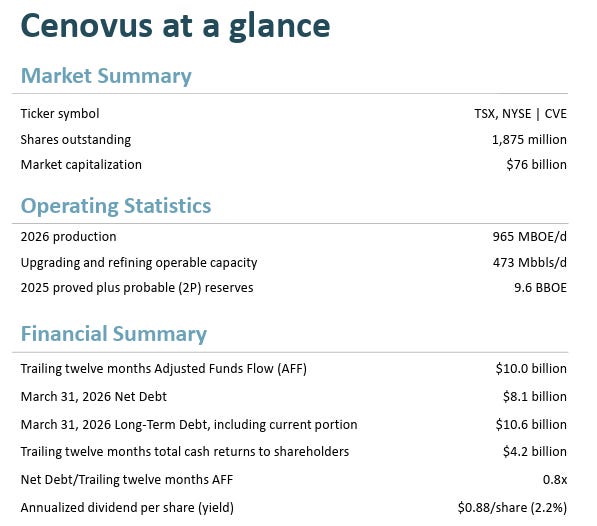
Cenovus Energy is one of Canada’s largest integrated energy companies, with a model that spans the entire heavy oil value chain: from upstream production — oil sands, conventional and offshore — to upgrading and downstream refining in Canada and the United States. This physical and economic integration is the central piece of the thesis, because it allows Cenovus to capture margin both from the Canadian light-heavy differential, WTI-WCS, and from refining cracks, precisely cushioning the volatility that tends to punish pure-play heavy oil producers. Headquartered in Calgary and led by Jon McKenzie, the company produces around 965k boe/d and has operable upgrading and refining capacity of 473k bbls/d. As of the end of June 2026, it has a market capitalization of roughly C$66 billion, with approximately 1.875 billion shares outstanding. Where Saturn was leverage and execution, and Whitecap was quality and prudence, Cenovus is scale and the vertically integrated barrel of the Canadian integrated player — investment grade — to play the same higher-for-longer environment.
Its asset portfolio is built around two major blocks with very different profiles:
Upstream. Dominated by oil sands, low-decline, very long-life thermal SAGD assets, with five main engines: Christina Lake, at around 359k boe/d, already including the MEG asset; Foster Creek, at around 225k boe/d; Lloydminster thermal and conventional heavy oil, at around 131k boe/d; Sunrise, at around 59 MBOE/d; and a diversified offshore business. On top of this, the Conventional segment, at around 122k boe/d, is short-cycle and liquids-rich, providing flexibility.
Downstream. Upgrading and refining, with around 55% of capacity geared toward heavy crude. After selling its 50% stake in the Wood River and Borger, WRB, refineries in September 2025, all refining is now 100% owned and operated, simplifying the structure and sharpening the focus on the core assets of the heavy oil chain.
At the reserve level, the backing is exceptional and supports a very high terminal value and asset life:
1P, or proved reserves: 6.135 billion boe.
2P, or proved plus probable reserves: 9.607 billion boe, or 9.6 billion boe.
2P RLI: around 28 years.
And the cost structure is among the best across its peer group, with a combined operating and sustaining capital cost in the oil sands of around C$21/bbl. As a result, Cenovus can be considered a very low-cost producer, where both sustaining capital and the base dividend are covered at US$45 WTI, and all growth investments exceed their return thresholds at US$45 WTI. In other words, the business works at the bottom of the cycle without giving up leverage to the upside.
The transaction that changes everything for the company is the acquisition of MEG Energy, completed in November 2025. For consideration of C$3.4 billion in cash, financed in part with a C$2.7 billion loan, plus 143.9 million Cenovus shares, the company added more than 100,000 bbls/d of low-cost, long-life oil sands production — the Christina Lake North asset, adjacent to its own Christina Lake — consolidating a dominant position in the area. By the end of the first quarter of 2026, corporate integration and the initial capture of synergies were practically complete, and the redevelopment program had already delivered first oil in April. But what is truly relevant for investors is the timing: 2025 was the final year of a three-year investment cycle, including Narrows Lake, Foster Creek optimization and West White Rose, meaning the free cash flow profile structurally inflects from 2026 onward, just as growth arrives and growth capex falls.
Before getting into the thesis, it is worth putting the opportunity into context, because since the May recap, the picture has changed in appearance but not in substance. Crude has collapsed, the war premium has evaporated, and we are back to pre-conflict levels, with WTI around US$70/bbl and Brent in the low US$70s, as if the Strait of Hormuz disruption had already been resolved and filed away. My reading, the same one I have been defending since Saturn and Whitecap, is that the market is looking at the wrong clock. Bulls and bears do not really disagree on supply and demand, but on the time horizon. The short-term physical market has eased, fair enough, but the medium-term structural deficit has not gone anywhere; it has merely been postponed. And what has driven the price lower is mechanical and temporary, not fundamental: the release of the roughly 170 Mb that had been trapped in the Gulf once transit reopened, a one-off logistical adjustment rather than new supply; China cutting refinery runs and drawing from its own inventories instead of buying incremental crude; and an almost depleted SPR, with three to six weeks of releases still ahead. Meanwhile, the signal that really matters over the medium term, inventories, remains historically tight and continues to fall, to the point that a simple price-inventory regression places fair value for WTI at around US$87/bbl, 26% above where it trades today. Refining margins are at highs, physical differentials remain firm, with refiners competing for barrels, and Iran continues to keep the threat in Hormuz alive through recent attacks on vessels, which is precisely the nuance consensus is overlooking. OPEC spare capacity only matters if it is deliverable, and deliverability is not the same thing as production. Higher for longer, also in crude.
There is, however, a specific twist in Canadian heavy crude that should not be overlooked: the WTI-WCS differential widened in the first quarter of 2026 due to excess supply of heavy grades, with OPEC+ unwinding cuts and Venezuelan barrels re-entering the market after Maduro’s fall. For a pure-play heavy oil producer, that would be a headache. For an integrated player like Cenovus, which refines its own barrel, it is almost an internal trade between the two sides of the business. The question, therefore, is the usual one: after the MEG merger, the end of the capex cycle and the cash flow inflection, and after years of sector discount, is Cenovus the lower-risk way to play this higher-for-longer setup — an investment-grade integrated company that compounds per-share value through dividends and buybacks — or do Canadian heavy crude, with its differentials, royalties, capital intensity and regulatory risk, structurally limit the upside?
Investment idea
To answer the question of whether Cenovus can be a good investment opportunity at these prices — after rising 74% over the past twelve months — we are going to analyze the following sections:
Assets and business units
Operations and financials
Balance sheet and shareholder return
Valuation
Let’s get started.
