

Disclaimer
LWS Financial Research is NOT a financial advisory service, nor is its author qualified to offer such services.
All content on this website and publications, as well as all communications from the author, are for educational and entertainment purposes only and under no circumstances, express or implied, should be considered financial, legal, or any other type of advice. Each individual should carry out their own analysis and make their own investment decisions.
Introduction and business model
H&R Block is a provider of tax infrastructure. It is a structural intermediary between taxpayers and the regulatory complexity of three key jurisdictions: the United States, Canada, and Australia. Its model combines assisted tax preparation and DIY (do-it-yourself) solutions, distributed through multiple channels— in-person, online, mobile, virtual, and desktop software—allowing it to capture both the traditional and the digital customer. This is complemented by the sale of ancillary financial products under its own brand and in partnership with banking partners, increasing the average ticket beyond the mere tax return. In parallel, through other services such as Block Advisors and Wave, the company has extended its value proposition to the small-business segment, offering year-round bookkeeping, payroll, advisory, and payment processing. This vertical partially reduces the seasonality inherent in the core business and strengthens recurring revenue. In terms of scale, H&R Block is one of the largest providers of tax return preparation and electronic filing services in its three main markets, with 22.8 million returns filed in fiscal year 2025.
With respect to seasonality, most customers file between February and April, which implies that a substantial portion of revenue is generated in an extremely narrow window. It is a campaign business. The model, while simple, depends heavily on human capital and is therefore not very scalable nor particularly high quality. As of the end of June 2025, it had approximately 4.300 permanent employees, but peak headcount—including seasonal staff—reached 70.100 people during the last tax season. The ability to recruit, train, and supervise this temporary workforce is as strategic an asset as its office network or its software.
Ultimately, the business rests on two structural pillars:
Reputation and brand trust, fundamental in a service where errors have legal and financial consequences.
Operational capacity to absorb massive demand spikes within very tight time windows.
The model can be broken down into the following blocks:
Assisted Tax Preparation: Preparation in company-owned offices. It remains the main volume driver.
DIY Tax Preparation: Self-prepared returns on the digital platform. In 2024, 3.8 million returns were filed versus 11.4 million assisted in the U.S., showing that the assisted model remains dominant.
Royalties: 30% of U.S. franchisees’ revenues.
Refund Transfers: Allow fees to be deducted directly from the tax refund, reducing payment friction.
Peace of Mind: Audit and error coverage, with defined limits.
Emerald Card and Spruce: Mastercard-branded financial products where refunds are received and funds can be added throughout the year.
Emerald Advance: Short-term loans ($350–$1,300), offered in November–December and repaid on March 31, generating interest and fee income.
Wave: Digital platform for small businesses integrating financial and tax services.
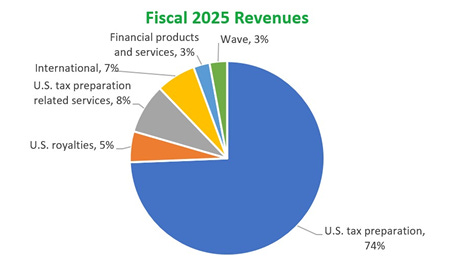
Although it has many product lines, the core of the business is structured around assisted preparation, making it clear that many customers want to be guided through the process and not worry about it. Customers can go to a physical office, submit documentation digitally, approve the return online, or request professional review of a previously prepared return (Tax Pro Review). The 100% accuracy guarantee is a structural part of the model. For assisted returns, the company reimburses penalties and interest arising from errors attributable to H&R Block. In the case of DIY, coverage is triggered if the software makes an arithmetic error, with a $10,000 limit in the U.S. In this way, there is an explicit transfer of responsibility that reduces friction and sustains the value proposition in a service where mistakes have direct economic consequences. Geographic expansion (in the U.S. as well as in Canada and Australia) relies on franchises. In the U.S., franchisees pay roughly 30% of gross revenues from preparation and related services as a royalty. Economically, this turns part of the business into a recurring, high-margin, low-capital stream. The brand, software, and central support are monetized without bearing the full operating cost.
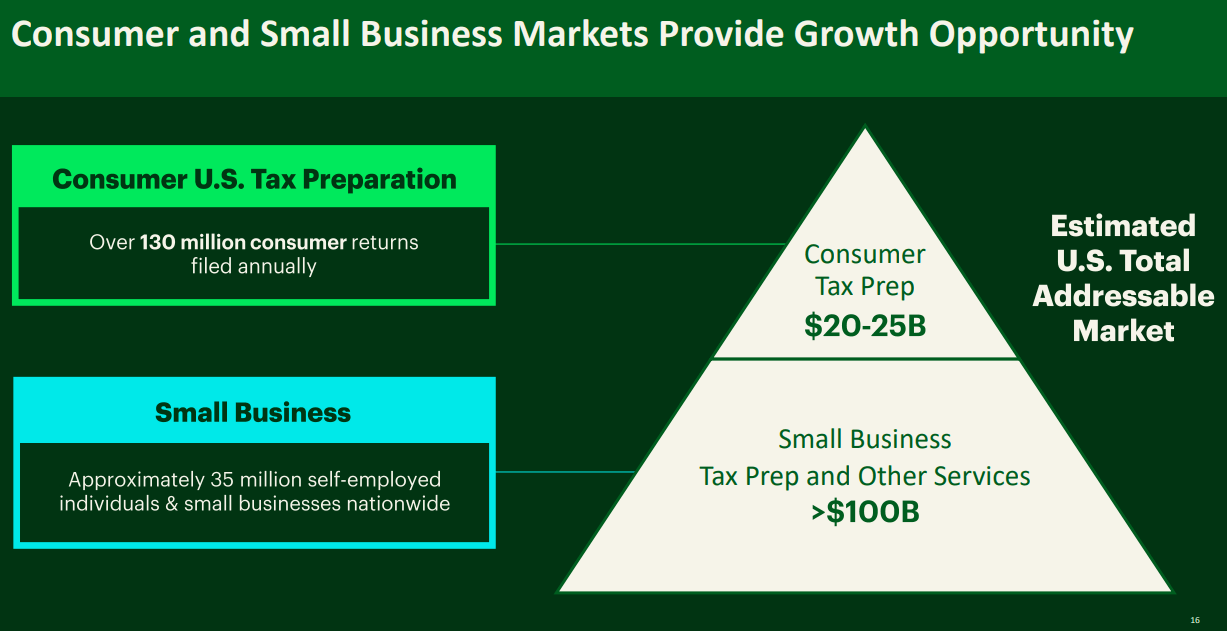
In recent quarters, there has been a clear strategic shift at the company toward focusing on the SME segment, where it believes customer lifetime value is much higher, there is more market room to grow, and switching costs to DIY solutions are higher than in the individual segment. There is a large number of SMEs and self-employed workers in the U.S. (>35M) which, in terms of business volume, are equivalent to 4x the retail market, making the rationale for the strategic shift clear.
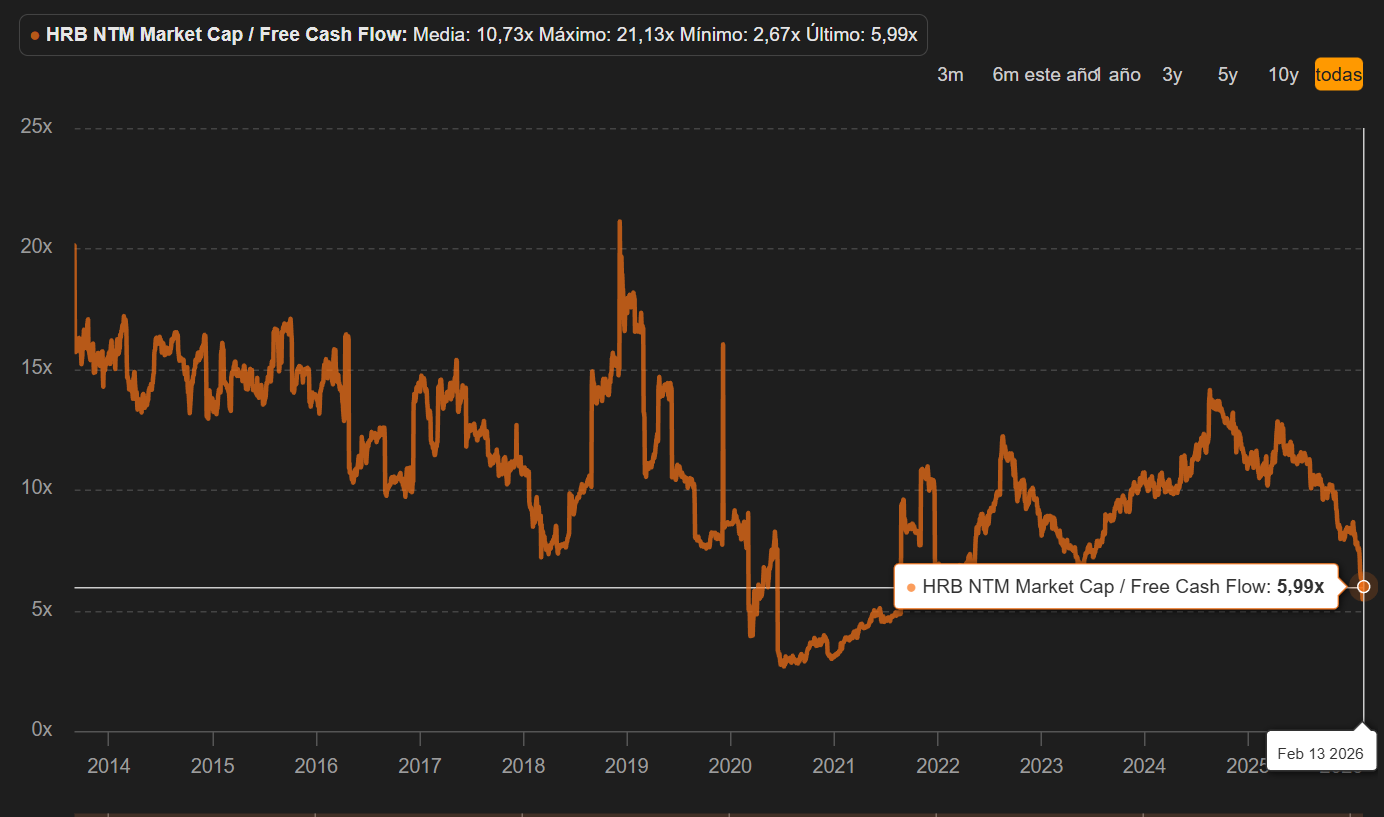
H&R Block’s valuation, heavily weighed down by fears of a total AI disruption, is at multi-year lows (excluding 2020, when FCF collapsed), at <6x. When we see a valuation at this level, the market is telling us the business is in clear decline, close to disappearing, and that its terminal value is zero; in this analysis we will examine whether we are truly seeing HRB’s final days (and therefore a value trap) or whether this is a major contrarian opportunity.
Investment idea
To answer the question of whether H&R Block could be a good investment opportunity, we will analyze the following sections:
AI Disruption
Operations and financials
Balance sheet and shareholder return
Valuation
Let’s get started.
