

Disclaimer
LWS Financial Research is NOT a financial advisory service, nor is its author qualified to offer such services.
All content on this website and publications, as well as all communications from the author, are for educational and entertainment purposes only and under no circumstances, express or implied, should be considered financial, legal, or any other type of advice. Each individual should carry out their own analysis and make their own investment decisions.
Weekly macro summary
There have been quite a few interesting events to analyze this week, and below I list the most noteworthy news. Let’s get started:
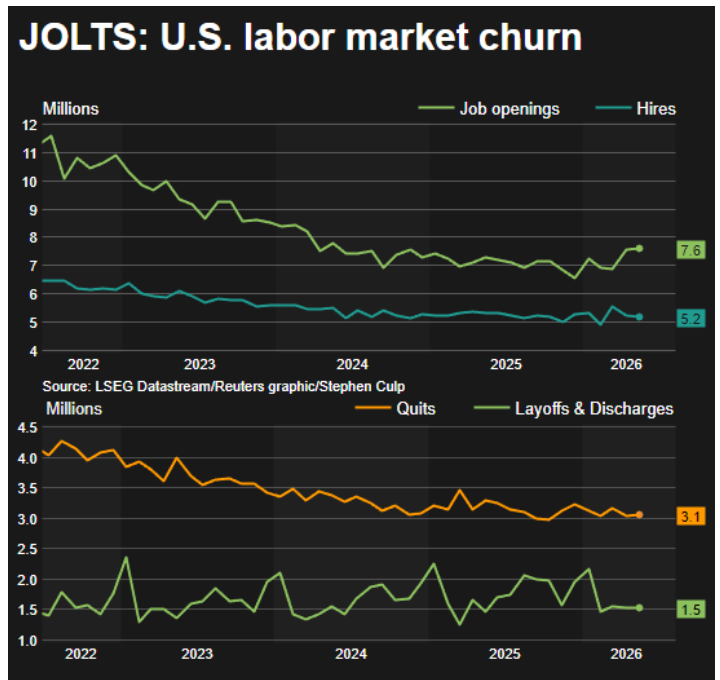
The U.S. labor market continues to send mixed signals, allowing almost any narrative to be defended depending on which data point one looks at. Job openings rose slightly in May to 7.59 million, the highest level in two years, while the ratio of available jobs to unemployed workers remained at 1.04, broadly stable. At first glance, this does not look like a labor market deteriorating aggressively. But beneath the surface, the details are considerably less reassuring.
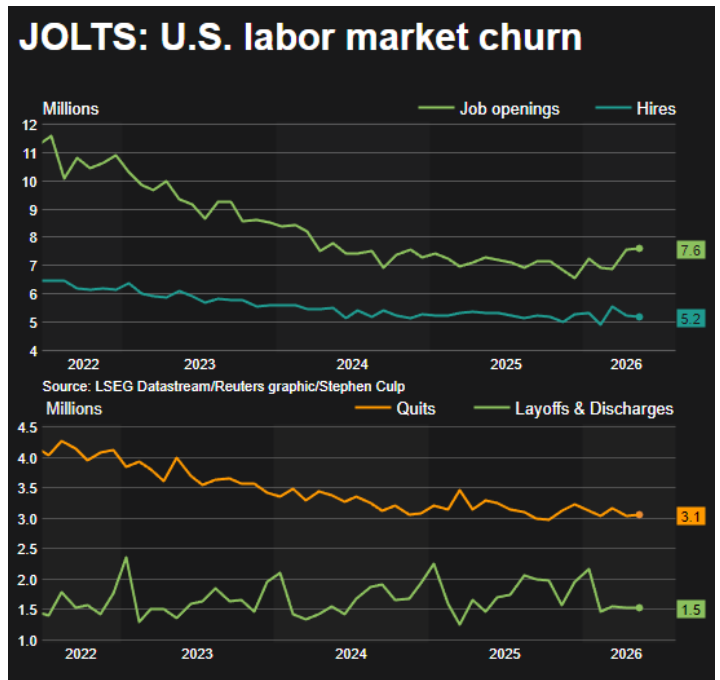
Hiring fell for the second consecutive month, to 5.17 million, and the pace of private-sector hiring weakened again, even though May’s nonfarm payrolls had shown solid job creation. The most uncomfortable data point comes from consumer perception. The share of respondents who consider jobs “hard to get” rose to 22.5%, the highest level since January 2021. At the same time, the Conference Board’s labor differential — the gap between those who see jobs as plentiful and those who see them as scarce — narrowed to 2.4 points, a level that has historically tended to correlate with a rise in the unemployment rate. In other words, even if companies are not laying off workers en masse, households are beginning to feel that the labor market no longer has the same momentum.
The problem with the current data is that there is increasingly more noise. The JOLTS report, already volatile by nature, has a very low response rate: barely 24% of contacted firms take part, compared with 35% two years ago and around 70% at the end of the previous decade. This increases the risk of bias and means the figures need to be treated with more caution than usual. Even so, the overall direction seems clear: for now, there is no collapse, but there is cooling. Job openings are holding up, layoffs remain low by historical standards, but hiring is moderating and quits remain depressed, a sign that workers no longer see it as so easy to switch jobs in order to improve their conditions.
For the Fed, the reading is relatively comfortable in the short term. As long as the labor market does not break, the focus can remain on inflation. In fact, with the conflict between the United States, Israel, and Iran apparently contained by a fragile truce and oil prices correcting, the central bank has somewhat more room to prioritize price stability. The market is already pricing in the possibility that the Fed could raise rates again this year, after keeping them in the 3.50%–3.75% range.
The institutional and moral deterioration in the United States is accelerating just as the country celebrates its 250th birthday. Trump has reported more than $1.4 billion in income from his crypto businesses in 2025, according to his latest financial disclosures filed with the Office of Government Ethics. The figure is extraordinary not only because of its size, but because of what it represents: the bulk of the president’s income no longer comes from hotels, golf courses, real estate licensing, or resorts, but from digital assets that have directly benefited from the regulatory shift of his own administration and from a pump-and-dump scheme.
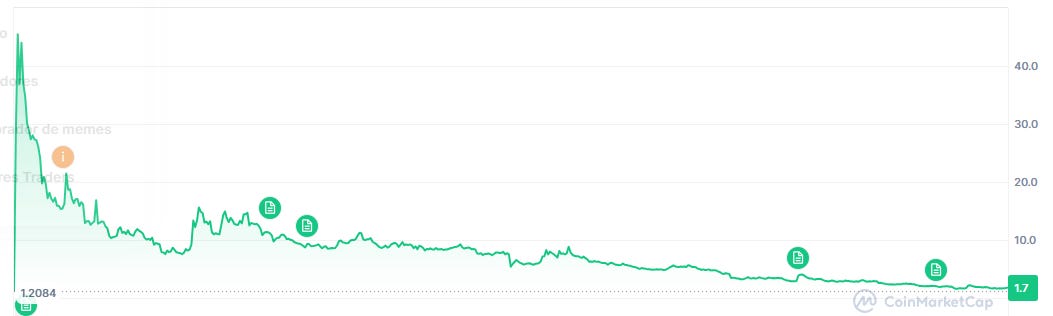
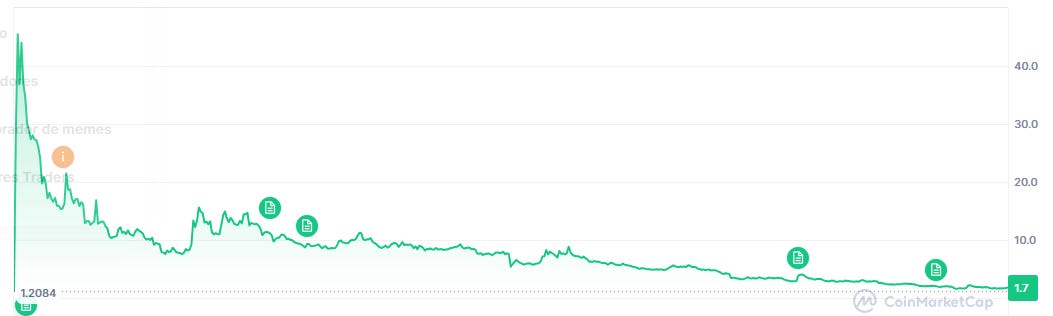
The main driver has been World Liberty Financial, the crypto project co-founded by Trump and his sons, from which his companies received nearly $800 million. Within that figure, more than $520 million came from token sales and another $250 million from the sale of stakes in the business itself. On top of that, he earned another $635 million from the sale of his memecoins. Altogether, Reuters estimates that the Trump family has generated at least $2.3 billion from crypto-linked projects since his return to the White House.
Trump has pushed an openly pro-crypto agenda: federal rules for stablecoins, reduced regulatory pressure from the SEC and the Department of Justice, and an explicit narrative of turning the United States into the “crypto capital of the world.” The fact that, at the same time, a large part of his personal wealth has become dependent on that very same sector creates a conflict of interest that is hard to disguise, even if the president and vice president are legally exempt from many of the ethics rules that apply to the rest of the executive branch.
The White House denies any conflict and argues that the businesses are managed by his sons. But from an economic standpoint, that distinction matters little, since Trump remains the beneficiary of the trust that receives those revenues. This is not a marginal or symbolic exposure, but a complete transformation of his personal balance sheet. Just a year ago, World Liberty generated around $57 million for him in token sales. In the new disclosure, that figure has multiplied by nine.
Meanwhile, his traditional businesses continue to operate, but they have been pushed into the background. His golf courses and resorts brought in just over $500 million, with Mar-a-Lago jumping from $50 million to $77 million after consolidating itself as a kind of “Winter White House.” The Trump brand also continues to be monetized overseas, especially in the Middle East, with more than $50 million in real estate licensing income. The case illustrates a broader and increasingly uncomfortable trend: the line between political power, industrial policy, and private enrichment is becoming blurred. In other strategic sectors, the state takes stakes or attaches conditions to public support. Here, the movement is almost the reverse: a president with direct power to shape the regulation of an industry personally captures a huge share of the upside from that same industry.
The question is not whether crypto has gained institutional legitimacy under Trump. That is already clear. The question is who has benefited from that legitimacy. And in this case, the answer seems fairly obvious. The presidency has not only changed the regulation of the sector; it has also changed the personal fortune of the person leading it.

OpenAI has reportedly proposed that the U.S. government take a 5% equity stake in the company, in a structure inspired by the Alaska Permanent Fund, which would use the future capital gains of major AI companies to finance dividends or public benefits. The idea would not be limited to OpenAI, but would seek to extend to the rest of the major U.S. labs, although it is not clear whether companies such as Anthropic, Google, or xAI would be willing to accept something similar.
The news fits perfectly with a trend we have been seeing for months, in which the U.S. government is no longer acting only as a regulator or financier, but is beginning to behave like a strategic shareholder. We have already seen this in semiconductors, critical minerals, and sensitive supply chains, where subsidies and public support are increasingly being converted into equity stakes. Now that logic is being applied to artificial intelligence, probably the most important — and politically sensitive — sector of the next decade.
AI concentrates enormous valuations, requires a massive amount of capital and energy, and at the same time threatens to create highly visible labor-market disruptions. According to recent surveys, a significant share of Americans fear that AI could destroy jobs in their household. In that context, the idea that a handful of private companies should capture almost all of the economic upside from a technology built, in part, on infrastructure, data, collective knowledge, and public support is becoming politically difficult to defend. For OpenAI, the move may be a way to buy regulatory stability ahead of a future IPO. Giving 5% to the government may look expensive, but if in return it reduces the risk of more aggressive intervention, operational restrictions, or targeted taxes, it could end up being a reasonable insurance policy. Especially in an environment where Washington has already intervened in the launch timeline of advanced models, and where the line between national security, technology regulation, and industrial policy is increasingly blurred. In fact, this is one of the most discussed mechanisms for establishing a universal basic income.
If the government takes equity stakes in the major AI companies, even through a public vehicle, it would completely change the nature of the sector. We would no longer be talking only about private technology companies, but about semi-public strategic infrastructure, similar in importance to energy, defense, or telecommunications. That could reduce certain regulatory risks in the United States, but it also opens an international Pandora’s box: if Washington demands a stake so that its citizens can participate in the upside of AI, why wouldn’t Europe, India, or any other relevant market do the same? At its core, what we are seeing is the natural continuation of resource nationalism, but applied to intellectual and computational capital. In the past, governments wanted to secure oil, uranium, copper, or semiconductors. Now they also want to secure a share of foundation models. AI is becoming a strategic commodity — only instead of being extracted from a mine, it is trained in data centers.
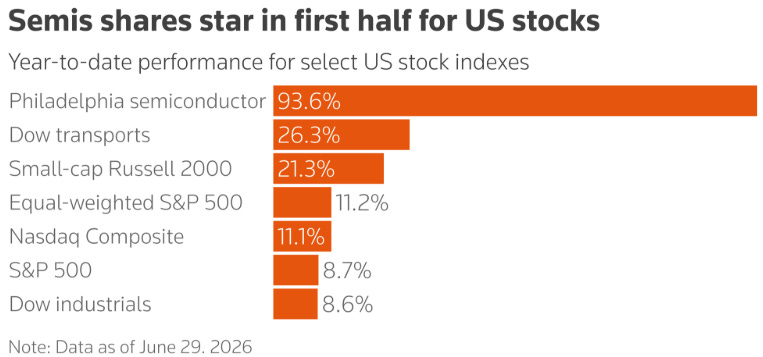
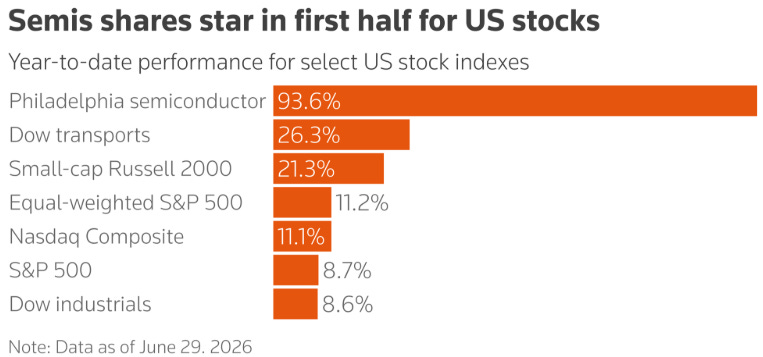
The S&P 500 closed the first half of the year up 8.7%. That sounds like a calm, almost boring year, yet it does not capture what has actually happened. Just look at the Philadelphia Semiconductor Index, which rose 93.6% over those same six months, to understand where almost all of it came from. If you take the S&P itself and, instead of weighting it by size, give every company the same weight, the gain is just 11.2%. That gap between one version and the other is, essentially, one single sector pulling the cart. The Russell 2000 rose 21.3% and transports gained 26.3%, but the headline belongs to chips. What we call “the U.S. stock market” is today a leveraged bet on semiconductors, which in turn are a leveraged bet on hyperscaler spending.
And that spending, to be fair, is not smoke and mirrors. Amazon, Microsoft, Google, and Meta are set to spend around $725 billion in capital this year, 77% more than in 2025, with consensus already talking about surpassing one trillion in 2027 and Goldman adding up to $5.3 trillion between now and 2030. Nvidia collects the toll on that highway, and trades as if that toll will never stop being paid. What has changed in recent months is that the market has stopped applauding spending for its own sake and has started demanding accountability. Meta fell 9% on the day it raised its capex forecast. Alphabet was punished for the same reason. Amazon’s free cash flow is flirting with turning negative. And Nvidia, which seemed untouchable, saw $600 billion in market value wiped out in a single session in January, the largest one-day loss in history for a listed company. The underlying question is the same as always, even if it comes wrapped in shiny paper: does all this money earn its cost of capital, or does it merely look like it does?
Because a large part of the demand is suspiciously circular. More than $800 billion in deals have been counted where the supplier finances its own customer. Nvidia puts $100 billion into OpenAI, OpenAI signs with Oracle, Oracle buys Nvidia chips, and the same dollar ends up being counted as revenue across three different balance sheets. With the uncomfortable detail that OpenAI is on track to lose around $14 billion this year, almost triple last year’s figure, while credit default swaps on Oracle and Microsoft have almost doubled since September, and that MIT study reminds us that 95% of corporate AI investments still have not delivered a measurable euro in return.
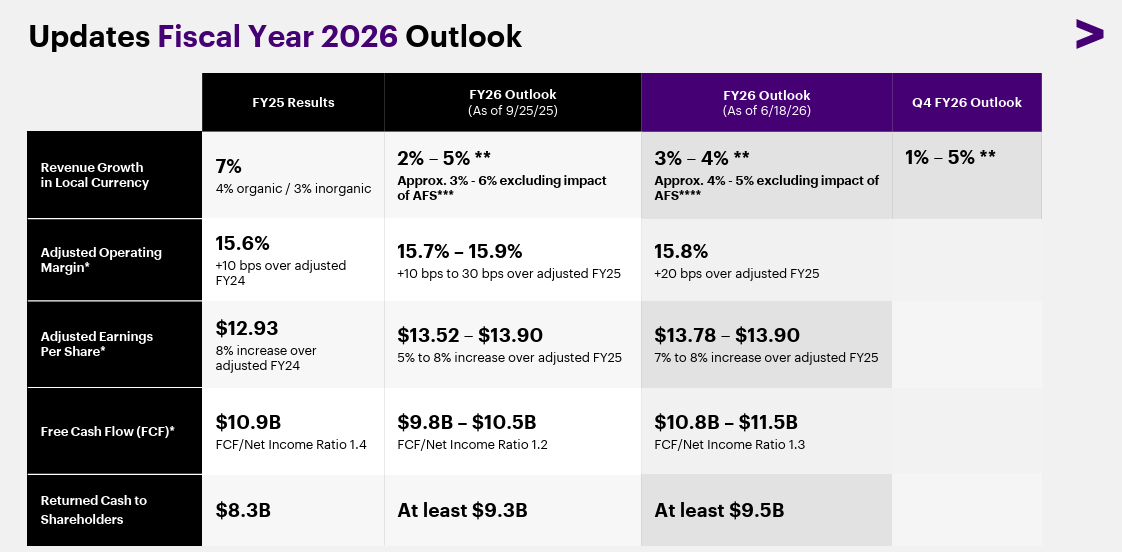
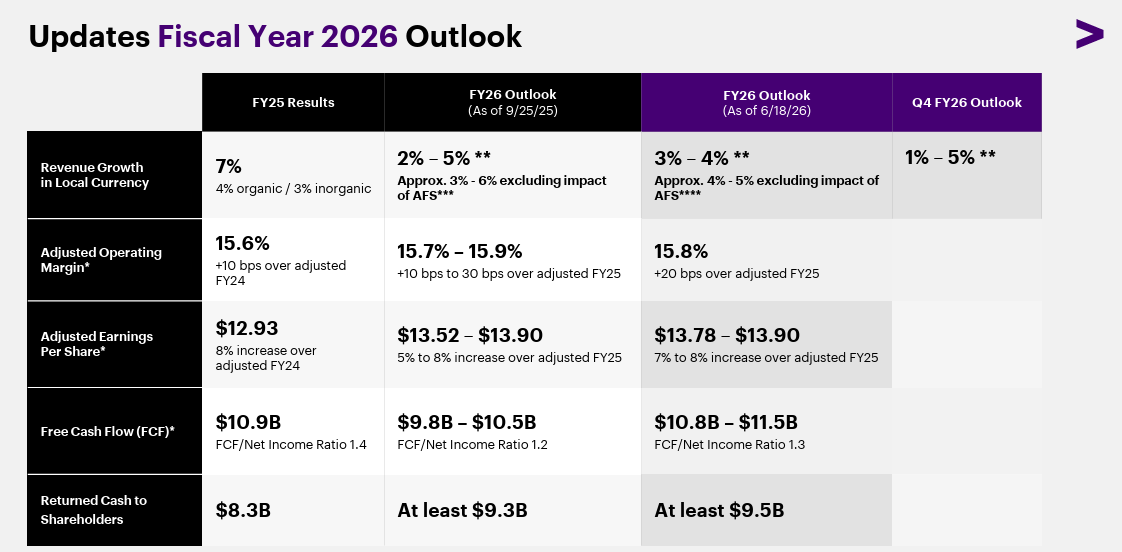
I am not saying AI is fake. I am saying the price already assumes it is not, with no room for doubt or error. In the meantime, I continue buying barrels, copper, and businesses that throw off cash at six times earnings, while others pay forty times for the fish biting its own tail. The party is going wonderfully, it must be said. And in this same context, there are a number of companies that have been labeled as “irreversibly disrupted” and have fallen more than 80% in just over a year, after being compounders and examples of quality for decades, while their businesses do not yet seem to be suffering under the weight of that disruption. Some paradigmatic examples are ACN 0.00%↑ or ADBE 0.00%↑ , which continue to improve their businesses and trade at less than 10 times earnings, although the doubts around their terminal value are by no means resolved. Opportunity or value trap?

Model Portfolio
Year to date, the model portfolio is up +17.29%, versus +12.88% for the S&P 500 (S&P in euros), and +202.3% since inception (September 2022), compared with +69.6% for the S&P 500. The model portfolio, as of Friday's close, is as follows:
⚠️Past performance does not guarantee future results. The historical performance of the model portfolio is shown for informational and educational purposes only and does not constitute investment advice or an offer to buy or sell securities. The returns shown may not include fees, taxes, or other associated costs.
