

Disclaimer
LWS Financial Research is NOT a financial advisory service, nor is its author qualified to offer such services.
All content on this website and publications, as well as all communications from the author, are for educational and entertainment purposes only and under no circumstances, express or implied, should be considered financial, legal, or any other type of advice. Each individual should carry out their own analysis and make their own investment decisions.
Weekly macro summary
There have been quite a few interesting events to analyze this week, and below I list the most noteworthy news. Let’s get started:
GameStop’s bid for eBay looks more like financial spectacle than a conventional, serious corporate transaction. Anyone who watched the CNN interview where he was questioned about the financing will know exactly what I mean. Ryan Cohen is trying to buy a company almost four times larger, combining cash, stock, and a $20 billion financing promise in a transaction that the market, for now, does not believe. The evidence is in eBay’s share price, which rose barely 6% and remains well below the $125 offer price, reflecting a fairly low implied probability of the deal closing.
It is understandable that GME would want to acquire eBay, apply the same cost-cutting playbook it used at GameStop, and combine the online marketplace with a physical network of around 1.600 stores to compete more effectively against Amazon. On paper, it sounds ambitious, but the industrial fit is limited. eBay is an asset-light business built on charging commissions for connecting buyers and sellers; GameStop remains a traditional retailer, with inventory, physical stores, and a very different customer base. There is some overlap in collectibles, trading cards, and second-hand goods, but not enough to justify a transaction of this size.
The main problem is financing. GameStop has around $9 billion in cash, but it also has debt, and it is trying to buy a company of much greater scale. Issuing shares would massively dilute existing shareholders, as it would require more than doubling the current share base, while a leveraged buyout would turn the deal into one of the largest LBOs in history. In other words, for the deal to work, Cohen needs the market to accept a combination of faith, leverage, and GameStop paper. It is no surprise that analysts are asking for more details.
Even so, the offer could have consequences even if it fails. eBay had been performing well in the market, with investors recognizing its repositioning toward higher-value niches such as sneakers, luxury fashion, antiques, and collectibles. GameStop’s attempt could put it on the radar of other buyers, especially if the market starts to perceive that the business has more strategic value than its current valuation reflects.
The meme component is also back. Retail investors have reappeared as buyers of both GameStop and eBay, and some are already speculating about a kind of “GameStop Hathaway,” blending the Warren Buffett narrative with Reddit culture. But there is an important difference between building a rational conglomerate and financing a gigantic acquisition with a stock whose valuation depends largely on retail enthusiasm. Michael Burry has been especially critical, selling his entire GameStop position and arguing that the strategy is not transformational at all. In his view, the transaction is not really about competing with Amazon, but about dominating the collectibles and second-hand niche, at the cost of more debt and more dilution.
Half cash, half stock.
Coinbase has announced a workforce reduction of up to 14%, around 700 employees, as part of a broader process to turn the company into a leaner, faster, and more “AI-native” organization. Brian Armstrong’s official explanation combines the weakness of the crypto cycle and the inherent volatility of the business with the accelerating impact of artificial intelligence on internal productivity.
The cyclical part is easy to understand. Coinbase remains highly exposed to trading volumes and speculative appetite in the crypto market. Although the ecosystem is maturing — stablecoins, prediction markets, tokenization — revenues continue to swing sharply from one quarter to the next. In a bear market, cutting costs before the deterioration becomes deeper is a rational decision, especially for a company that has already lived through several cycles of euphoria and purge.
But Armstrong does not present the layoffs as a simple defensive measure, but rather as a structural reconfiguration of the company around AI. Fewer management layers, managers who are also individual contributors, small teams, “pods” capable of managing AI agents, and even the possibility of one-person teams combining product, engineering, and design. In other words, the company does not simply want to use AI as a tool, but to redesign its organizational structure around the premise that many white-collar tasks can be automated or compressed. For years, AI has been discussed as a productivity boost, but now we are beginning to see how that productivity translates into explicit headcount reductions. Not because the company is on the brink — Coinbase remains well capitalized — but because the standard of efficiency is changing.
If an engineer with AI can do in days what previously required weeks of work from a team, the traditional corporate structure starts to look bloated. Middle layers, pure managers, and large teams go from being a sign of scale to becoming a coordination cost.
Trump has signed several executive orders to revive Keystone XL and Dakota Access, two pipelines that had become symbols of Obama’s climate agenda and of environmental resistance in the United States. Keystone XL is the more symbolic case. Obama blocked it in 2015 because he believed that approving a major pipeline to transport Canadian crude to Gulf Coast refineries would undermine the United States’ credibility in international climate negotiations. Trump, by contrast, frames it as a matter of energy sovereignty and job creation, inviting TransCanada to resubmit its application and adding a politically useful condition: that the steel and pipes be manufactured in the United States. It is the same framework we will see repeated across many areas of his economic policy: more domestic energy, more infrastructure, more local content, and fewer environmental restrictions.
Dakota Access has a somewhat different dynamic, because the project was practically finished and only the section under the Missouri River remained, near the area where protests by the Standing Rock Sioux tribe and their allies were concentrated. For opponents, the issue was the risk to drinking water and culturally sensitive sites, but for the company, Energy Transfer Partners, the blockage was a political decision by the Obama administration. Trump explicitly aligns himself with this second interpretation and orders the pending permits to be accelerated.
What matters is that energy is once again at the center of U.S. industrial policy. The White House, especially after seeing the risks exposed by Iran, wants to unblock projects, reduce regulatory friction, and favor the oil industry. In practical terms, Dakota Access was far more likely to be completed quickly, since it was almost finished and did not require the same international process as Keystone, which had to cross the Canadian border and needed a presidential permit. But even before a single additional barrel starts flowing, the message has already been sent.
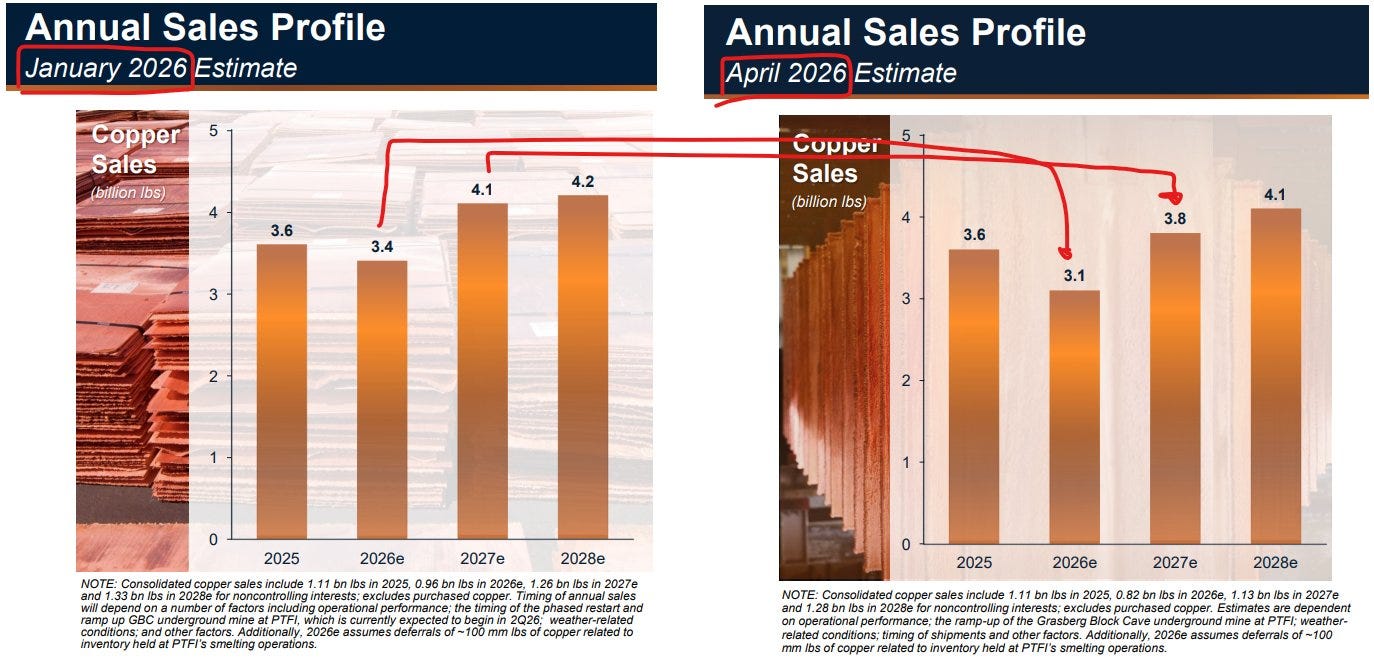
The outlook for copper supply continues to disappoint to the downside, as we have come to expect. After the revision and delays at Ivanhoe, we can now see that Freeport has also lowered its expectations over the past three months. A 10% cut to the production profile in a single quarter is highly significant for one of the world’s largest producers.
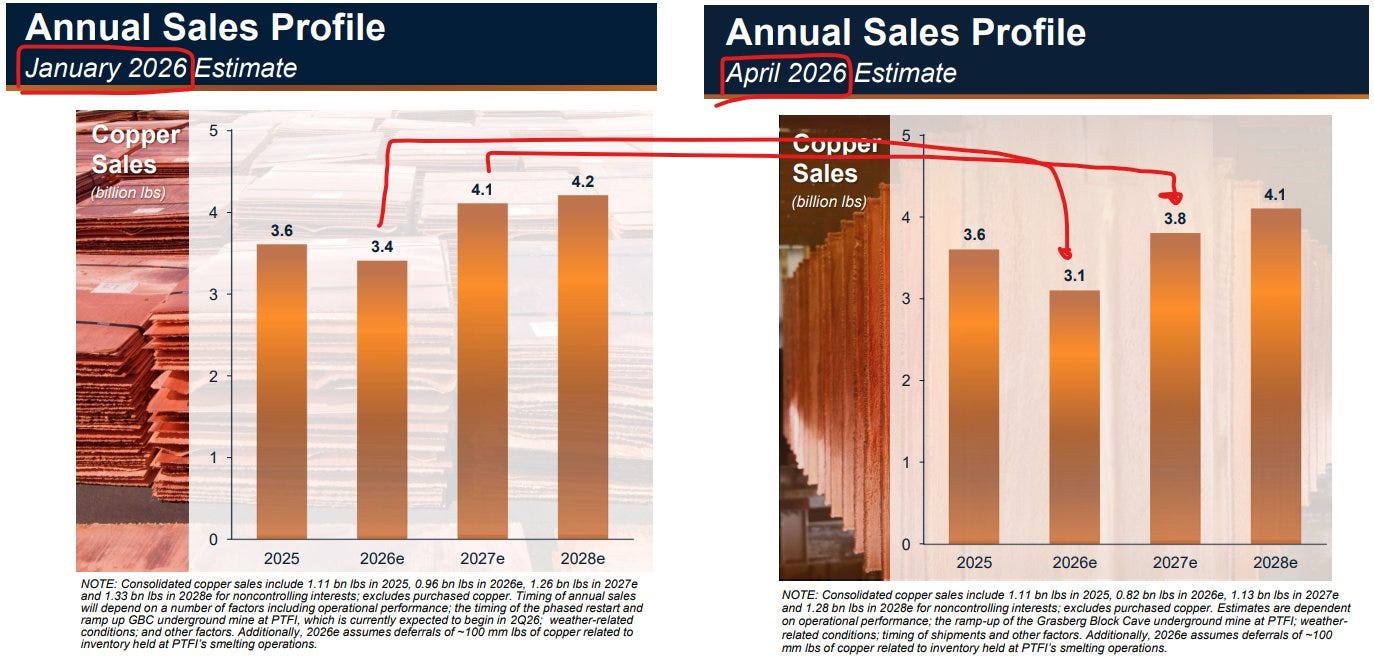
In fact, despite the economic slowdown that is already starting to filter through as a result of the Iran conflict, demand is holding up while supply keeps surprising to the downside, leaving the net balance more positive than expected. At the end of last year, when the Grasberg mine, one of the most important in the world, collapsed, we highlighted how relevant that event was for the copper price, which has risen more than 50% since then. Now, after issuing very optimistic guidance on the recovery and ramp-up, they have publicly acknowledged that it will take at least another year to restore activity. With prices comfortably above $6/lb, many explorers and producers are in a sweet spot to generate extraordinary value. If Iran allows it.
Another week in which we remain stuck in Groundhog Day, with constant peace headlines, almost always coming from the same unreliable source, which are then denied. In reality, there is no new information, just recycled material, but it achieves the desired effect of keeping crude prices depressed. The physical reality is that the Strait remains closed, and another 70 million barrels of inventories have been lost this week. In fact, the Iranian government has published the following form, which must be filled out by all vessels wishing to transit the Strait through a newly created body designed to manage the route, which seems to be an attempt to cement a new paradigm of control.

Additionally, tensions in the Gulf are escalating again just as the market was, wrongly, beginning to price in a diplomatic resolution to the conflict. The exchange of fire between U.S. and Iranian forces in the Strait of Hormuz, along with renewed attacks on the UAE, puts at risk a ceasefire that had barely been in force for a month. Trump has tried to play down the episode, stating that three U.S. destroyers crossed the strait under fire without suffering damage, while Iran accuses the U.S. of violating the ceasefire by attacking a tanker and civilian areas in Qeshm. As usually happens in these episodes, both sides claim victory and deny any meaningful damage, but the key point is not so much the military report as the strategic signal: the conflict is still very much alive.
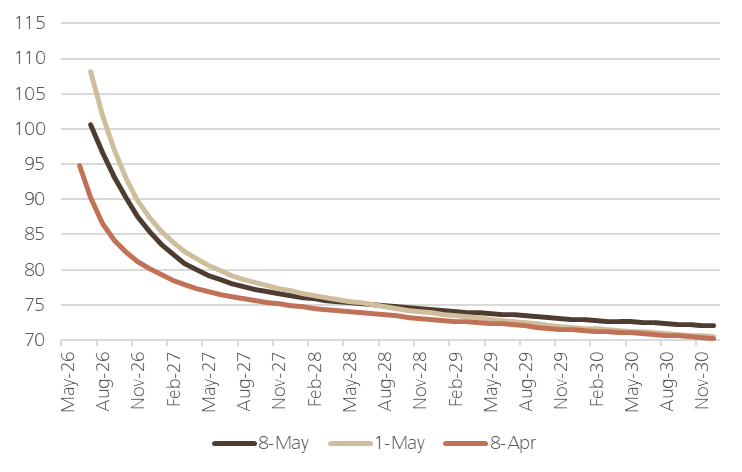
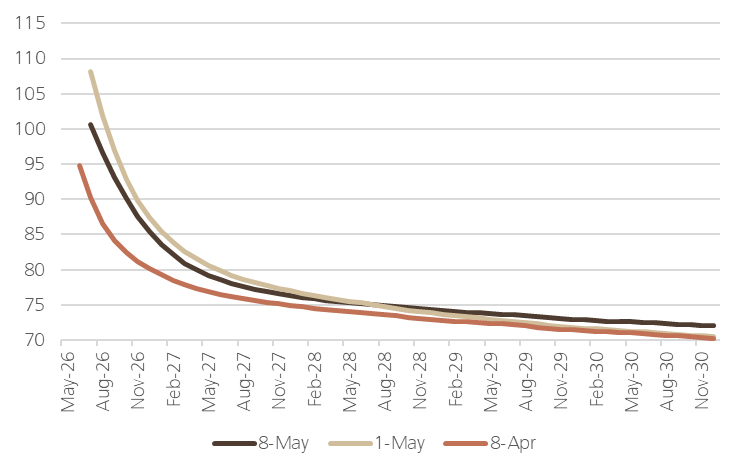
Despite the constant headlines and manipulation, which mainly affect the front month, meaning the crude for most immediate delivery, the entire curve has shifted higher over the past month and is now above $75/bbl for all of 2028. That would make all the valuation models currently considered consensus in the industry obsolete. My view is that we will see another upward shift during May, making the numbers even more interesting. The oil market continues to show a level of tightness that consensus seems unable to recognize. Historically, a 1–2% imbalance in global balances has already been enough to move prices violently, because oil is not priced based on the average barrel, but on the last available barrel.
At present, even including the SPR, the accumulated shortage is around 8.5 million barrels per day. The deficit exists, the inventory drawdown is real, and the headline of the day does not change much. In commodities, noise dominates in the short term, but balances eventually prevail. And right now, those balances still point to a market far tighter than the dominant narrative suggests.

Model Portfolio
Year to date, the model portfolio is up +17.58%, versus +5.92% for the S&P 500 (S&P in euros), and +203.1% since inception (September 2022), compared with +59.2% for the S&P 500. The model portfolio, as of Friday's close, is as follows:
⚠️Past performance does not guarantee future results. The historical performance of the model portfolio is shown for informational and educational purposes only and does not constitute investment advice or an offer to buy or sell securities. The returns shown may not include fees, taxes, or other associated costs.
