

Disclaimer
LWS Financial Research is NOT a financial advisory service, nor is its author qualified to offer such services.
All content on this website and publications, as well as all communications from the author, are for educational and entertainment purposes only and under no circumstances, express or implied, should be considered financial, legal, or any other type of advice. Each individual should carry out their own analysis and make their own investment decisions.
Weekly macro summary
There have been quite a few interesting events to analyze this week, and below I list the most noteworthy news. Let’s get started:
Samsung reported seemingly spectacular results, with second-quarter operating profit multiplying 19x year-on-year and even exceeding the combined earnings generated over the previous three years. In fact, it became the most profitable company in the world, ahead of Nvidia. On paper, the quarter confirms that the memory cycle remains firmly in expansion mode, driven by demand from AI data centers, aggressive price increases in DRAM and NAND, and the spillover effect of HBM into more conventional products. However, the market did not buy the narrative. The stock fell sharply, dragging SK Hynix and the KOSPI down with it, wiping out more than $80 billion in market capitalization.
As always, the excuse is that the good news was already priced in. Samsung had come off a strong rally, and the market did not just want a good quarter; it wanted confirmation that the memory supercycle can be sustained beyond 2025. And that is where the doubts begin, especially in such a cyclical sector. People often say that this time is different, but it never is. And in a sector this cyclical, where multiples depend more on the next turn in inventories than on the current quarter, a small nuance in pricing can matter more than a big earnings headline.
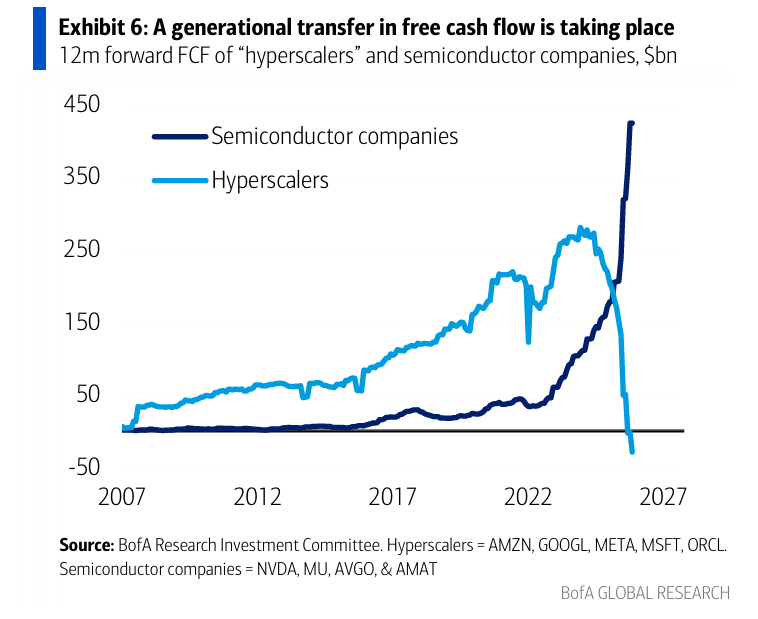
The underlying issue is not Samsung, but the sustainability of AI capex. The market is starting to question whether Meta, Microsoft, Amazon or Alphabet can continue increasing infrastructure investment at this pace, especially when much of the economic return remains uncertain. The bullish thesis in semiconductors has rested on a very powerful idea: hyperscalers have no alternative and must keep building capacity almost regardless of price. But if capital starts demanding discipline, the trade changes completely. Morgan Stanley is already talking about greater caution in capex, and that is enough to puncture a sector that had been riding a historic rally.
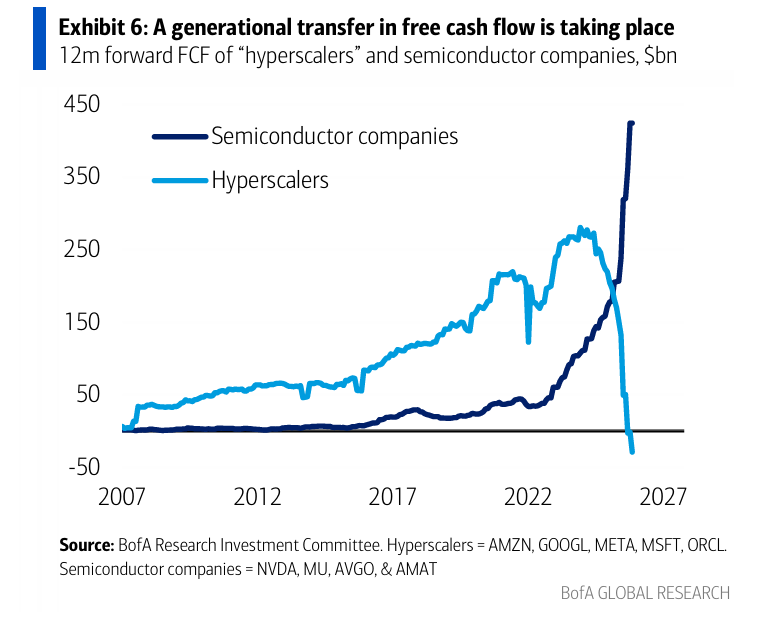
Another classic cycle risk is also emerging: supply. Samsung and SK Hynix have announced massive investments to capture AI demand, but every new dollar of capacity planted today can turn into tomorrow’s excess if demand cools. It is the old semiconductor story: when margins are extraordinary, everyone invests; when the new capacity arrives, the cycle may already have turned. For now, shortages in conventional memory continue to support prices, but the market is beginning to look beyond the quarter and ask whether this is a structural shortage or simply a very profitable cyclical peak.
China is beginning to treat its artificial intelligence models as strategic assets. Beijing has held meetings with Alibaba, ByteDance, and Z.ai to explore potential restrictions on international access to their most advanced models, including some that have not yet been released. This is not merely about limiting downloads or partially closing open-weight models, but also about treating any leak or theft of proprietary technology as a national security matter, while controlling who is allowed to finance domestic AI startups.
The move fits perfectly with the sector’s new geopolitical logic. Artificial intelligence is no longer a purely technological industry; it is becoming critical infrastructure, much like semiconductors, enriched uranium, or rare earths. The United States had already taken similar steps by restricting foreign access to Anthropic’s most sensitive models, particularly Mythos, which was designed for cybersecurity professionals and is viewed in China as a potential offensive tool against its interests. Beijing is now responding with its own version of export controls, applied not to hardware, but to the model itself.
The key point is that Chinese models had begun to gain global traction because of a combination that was deeply uncomfortable for the West: capabilities increasingly close to those of American models, but at much lower costs. Qwen, Doubao, and GLM-5.2 were becoming genuine alternatives for companies unwilling to pay the prices charged by OpenAI, Anthropic, or Google. If China limits international access to these tools, the effect could be twofold: on the one hand, it would protect its domestic technological advantage; on the other, it could raise the cost of AI adoption outside China by reducing competitive pressure on US models.
What is particularly interesting is that this also marks a shift in the open-source narrative. For years, model openness was presented as an inevitable, almost ideological force. But once the technology becomes strategically sensitive enough, the rhetoric changes. According to a Chinese legal debate published in a journal linked to the Supreme People’s Court, a tiered system is already being considered, with basic tools subject only to registration, advanced technologies requiring security reviews, and frontier models either banned from public release altogether or restricted to domestic use. In other words, open source is acceptable only as long as it does not touch the nerve of national power. At its core, we are seeing the same dynamic that unfolded in semiconductors, but at a higher layer of the value chain. First, controls were imposed on chips, lithography machines, and computing capacity. Now the output of that computing power—the models themselves—is beginning to be controlled. Technological globalisation continues to unravel layer by layer, and each bloc is trying to lock down its best assets before the other side can acquire them, copy them, or use them against it.
For companies, this introduces a new source of risk. Building products on cheap foreign models may be attractive in the short term, but if access ultimately depends on political decisions in Beijing or Washington, the real cost lies not in today’s pricing, but in the fragility of the technology supply chain.
AI is being nationalised at remarkable speed. And, as is often the case, the market continues to value many companies as though the digital world were infinitely scalable, open, and borderless. Every week brings more evidence that this era is over.
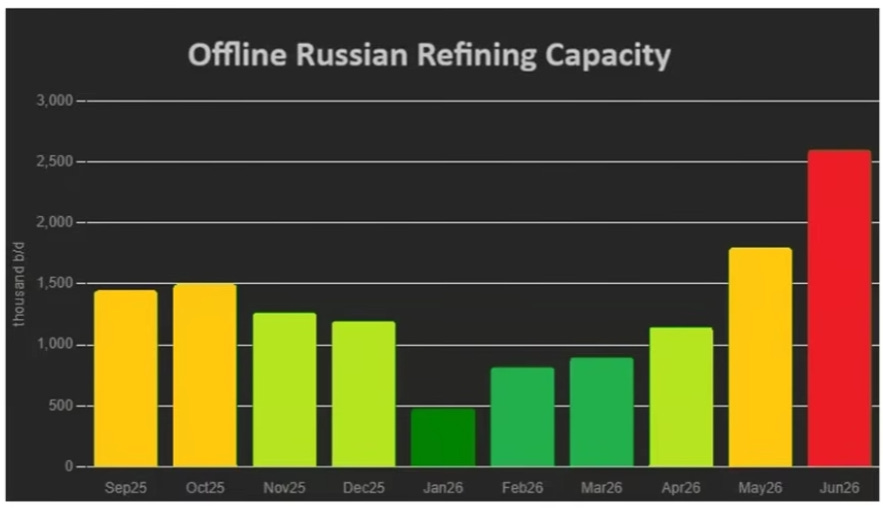
Russia has temporarily banned diesel exports until July 31, after Ukrainian attacks on refineries began to have a visible impact on the domestic market, leading to gasoline shortages, queues at filling stations, and growing pressure on prices. Moscow is now trying to redirect fuel toward domestic consumption, while opening the door to imports to offset the deterioration in its refining capacity. The measure also comes at a time when Russian exports had already collapsed. In June, seaborne shipments of diesel and gasoil fell by 39% month-on-month and 46% year-on-year, to approximately 1.8 million tonnes. During the first eight days of July, exports stood at just 214,000 barrels per day, well below the normal levels seen before the war. In practice, Russia was already operating under a de facto export ban.
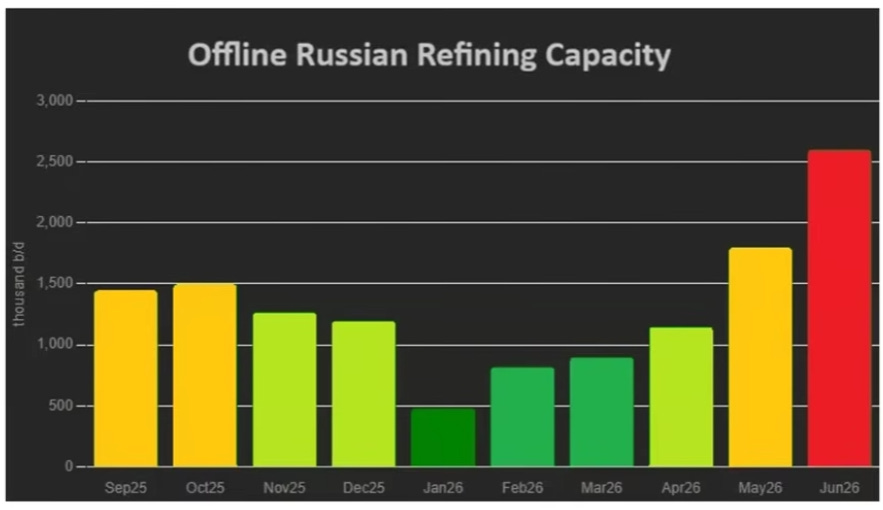
The impact of Ukrainian attacks on Russian refineries is beginning to spread beyond the country’s borders and threatens to become a regional problem for Central Asia. The diesel export ban has exposed the enormous energy dependence of several countries in the region, which for years had assumed that Russian supplies were virtually guaranteed.
Kyrgyzstan is probably the most vulnerable case. The country depends almost entirely on Russia to supply its domestic market and has already removed price controls on AI-95 gasoline, while seeking alternatives from Belarus, China, Uzbekistan, Turkmenistan, Azerbaijan, and Kazakhstan. The problem is that many of these potential suppliers do not have significant spare refining capacity either. Kazakhstan, despite being a major oil producer, has made it clear that it will only export fuel after securing its own domestic consumption.
The situation is similar in Tajikistan, which imported more than 80% of its petroleum products from Russia over the past year. The government claims to have reserves covering around 60 days, but it is already seeking aviation fuel from Kazakhstan and Turkmenistan while tightening price controls. Beyond the immediate shock, the episode once again highlights one of Central Asia’s major structural problems. The region produces abundant energy resources, but lacks sufficient refining capacity, logistical coordination, and trade integration to guarantee its own supply. For decades, governments have prioritised raw-material exports and short-term political stability, while placing the development of a more resilient regional infrastructure on the back burner.
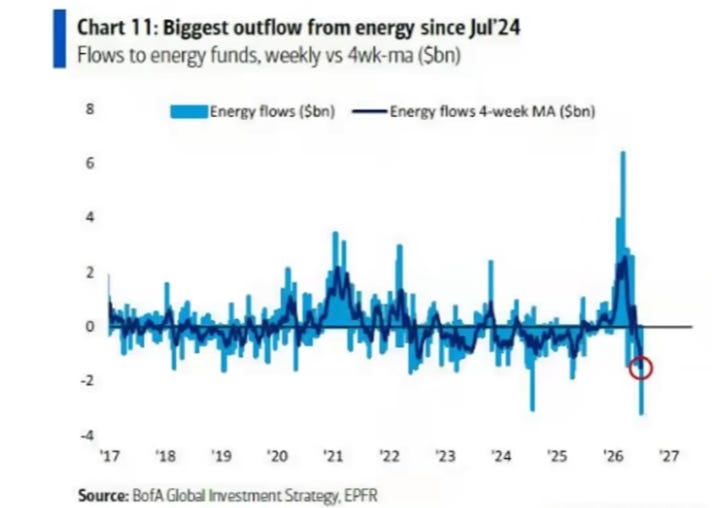
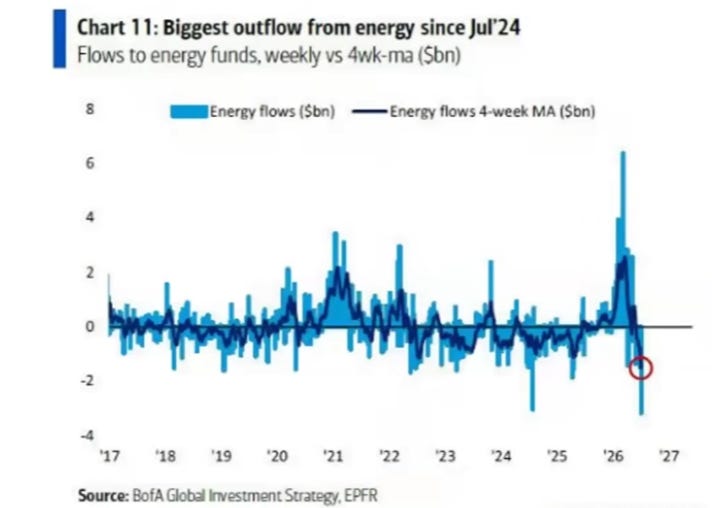
Despite the critical importance of these products and value chains, no one appears genuinely interested in maintaining them or investing in them. Not even during the greatest energy crisis in history—so far concealed by China’s buyers’ strike—have investment flows into the sector recovered. In fact, the industry has experienced the largest net capital outflow ever recorded. It certainly raises questions about the efficient-market hypothesis.
The ceasefire between the United States and Iran appears to have died before it even became anything resembling an agreement. Trump has declared the memorandum signed on June 17, under Pakistani mediation, effectively over, following the failure of indirect talks in Qatar and a new wave of U.S. strikes against Iranian positions. The 60-day window to negotiate a permanent solution has, in practice, closed, and the language has reverted to the usual one: military pressure, sanctions and controlled escalation… if such a thing even exists in the Middle East.
The immediate trigger was the attack on three cargo ships in the Strait of Hormuz, which Washington attributes to Iran, although Tehran has not formally claimed responsibility. The U.S. response has been twofold. On the one hand, new airstrikes on Iran’s southern coast, including strategic areas such as Bandar Abbas, Chabahar and Konarak, all relevant to the country’s naval and logistics infrastructure. On the other, the revocation of the license that allowed Iranian oil to be sold until August 21, shortening the settlement window for transactions to July 17. In other words, the tap is being turned off again exactly where it hurts most: energy revenues and the ability to finance the war. To be fair, these sales were highly unlikely anyway, as compliance mechanisms and caution worked against such a short window, and the most likely outcome is that this oil ends up in China, as usual.
Iran, as expected, has responded by raising the regional cost of the conflict. The attacks on Kuwait and Bahrain — both of which host a U.S. military presence — show that Tehran does not need to defeat the United States to make life difficult for it. It only needs to ensure that every move carries consequences in the Gulf, across maritime routes and among regional allies. In that sense, the Strait of Hormuz remains its major strategic card. Before the war, nearly one-fifth of global oil supply passed through it, and although the market has grown dangerously accustomed to geopolitical risk, the physical reality has not changed: if Hormuz is closed or partially disabled, there is no immediate substitute.
What is interesting is that oil barely reacted. Brent rose by around 1% to $78.8, far from the more than $120 seen in April. This tells us two things. First, that the market is still pricing in a limited escalation, not a full-blown war. Second, that there is enormous complacency around the ability to keep global energy flows open even in a direct conflict between the United States and Iran. The market may be right in the short term, but the asymmetry is clear: if the conflict remains contained, the impact is limited; if Hormuz breaks, the shock would be immediate.
Model Portfolio
Year to date, the model portfolio is up +18.00%, versus +14.49% for the S&P 500 (S&P in euros), and +204.2% since inception (September 2022), compared with +72.0% for the S&P 500. The model portfolio, as of Friday's close, is as follows:
⚠️Past performance does not guarantee future results. The historical performance of the model portfolio is shown for informational and educational purposes only and does not constitute investment advice or an offer to buy or sell securities. The returns shown may not include fees, taxes, or other associated costs.
