

Disclaimer
LWS Financial Research is NOT a financial advisory service, nor is its author qualified to offer such services.
All content on this website and publications, as well as all communications from the author, are for educational and entertainment purposes only and under no circumstances, express or implied, should be considered financial, legal, or any other type of advice. Each individual should carry out their own analysis and make their own investment decisions.
Weekly macro summary
There have been quite a few interesting events to analyze this week, and below I list the most noteworthy news. Let’s get started:
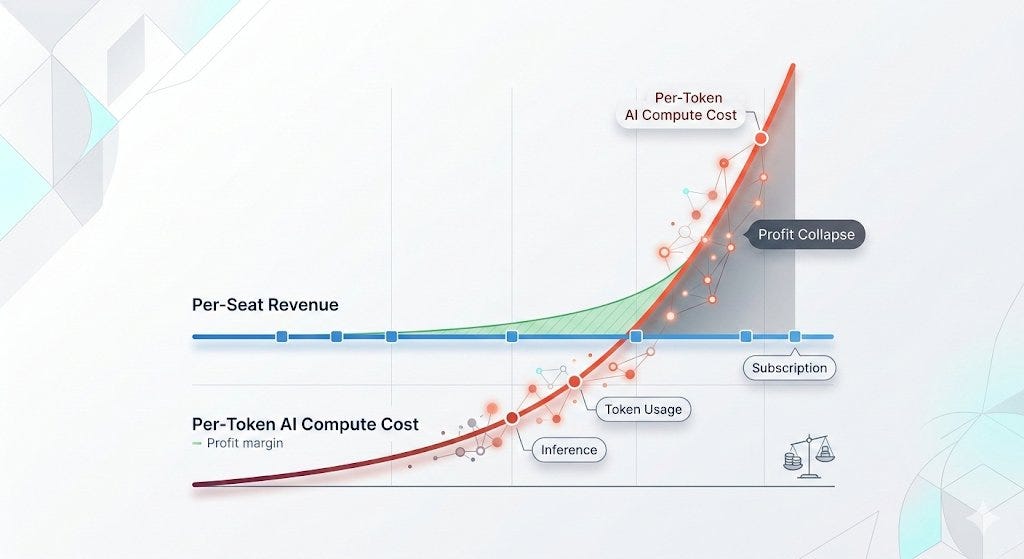
The era of subsidies in artificial intelligence is starting to run out in real time. Over the past two years, much of enterprise adoption has been built on an implicit premise: that inference costs would fall quickly enough to justify mass integrations, aggressive flat-rate pricing, and growing budgets. That premise is starting to break down.
The Microsoft case is paradigmatic. The same company that has invested $13 billion in OpenAI, and that also controls one of the world’s most important cloud infrastructures, has decided to cancel internal Claude Code licenses because token-based billing made the cost difficult to justify. We are not talking about a startup without financial muscle, but about a company with almost unlimited compute capacity. If even Microsoft looks at the bill and decides it is not worth it, the message for the rest of the market is fairly clear.
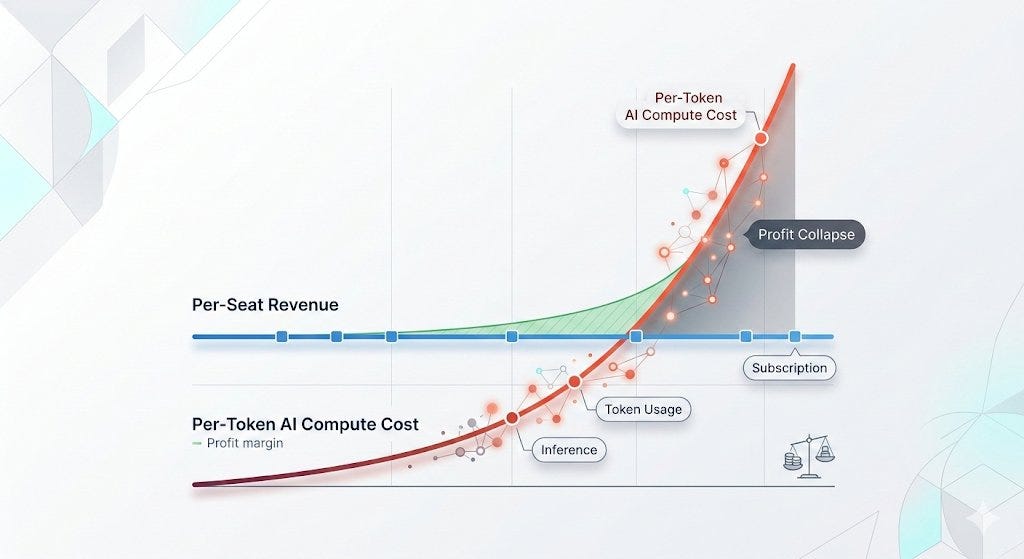
The problem does not seem to be the lack of usefulness of these tools, but rather the economic structure behind them. Usage-based billing is forcing enterprise customers to confront the real cost of running advanced models at scale. And that cost, once flat-rate plans or initial promotions disappear, is much higher than many companies had assumed in their internal models. Uber’s example points in the same direction: according to its CTO, the company reportedly consumed its entire AI budget planned for 2026 in just four months. It is a sign that adoption is moving faster than budgets can absorb.
At the same time, AI software prices in the United States have risen by between 20% and 37%, while GitHub — owned by Microsoft — is beginning to move away from flat-rate plans toward consumption-based models. AI companies, especially in a year of IPOs, can no longer keep giving away capacity indefinitely. They need to monetize actual usage, because the cost of serving these models remains material, especially in intensive workloads such as coding, agents, or automated workflows. This connects directly with the debate around Gemini Flash and the supposed structural collapse in inference prices. Yes, more efficient models exist and will continue to improve, but the commercial reality is more complex. Anthropic, OpenAI, and Google have raised effective prices in recent months, not lowered them. Competitive pressure is not eliminating the cost; it is merely redistributing it across labs, customers, and cloud providers. From here, the sector faces an uncomfortable dilemma. Either companies reduce usage to fit within their budgets, which would slow the revenue growth labs need to justify enormous valuations before going public; or labs cut prices again and absorb losses, further deteriorating unit economics that are already difficult to defend. In both scenarios, the narrative of unlimited growth starts to collide with a much more prosaic reality: someone has to pay the bill.
Korea is starting to show one of those classic symptoms of a late-stage euphoric phase: retail investors are not only buying the dominant narrative, they are buying it with borrowed money. The viral case of the civil servant who invested 2.3 billion won in SK Hynix, financing 1.7 billion through margin loans, is not relevant because of the individual himself, but because of what it reveals about the market mood. When these kinds of stories stop being seen as reckless and start being celebrated as examples of conviction, the cycle has already entered a different phase.
The Korean rally has been spectacular, driven by Samsung and SK Hynix itself. The KOSPI has gone from around 4,000 points to above 8,000 in less than half a year, fueled by enthusiasm around semiconductors, memory and AI-related demand. Consensus is beginning to project increasingly aggressive targets — J.P. Morgan is already talking about 9,000 points in its base case and 10,000 in its bull case — supported by a reasonable thesis: the memory cycle can remain “higher for longer” if AI demand continues to absorb capacity.
But the problem is not that the thesis is necessarily false. The problem is the price at which it is being bought and, above all, the risk structure being built around it. Leveraged positions in the Korean stock market have reached a record 36.47 trillion won, while the major brokerage houses generated 600 billion won in margin lending interest income in the first quarter alone, up 56% year over year. In other words, the brokerage business is directly benefiting from the transformation of retail optimism into leverage. The dynamic is familiar. First comes the rally, then FOMO, then financing that appears cheap, and finally the conviction that the cycle still has several years ahead of it. As long as prices keep rising, everything looks rational. Leverage accelerates gains, validates the narrative and attracts more participants. But margin is not permanent capital; it is unstable fuel. With rates at 7–9%, any sharp correction can turn a long-term thesis into a forced short-term liquidation.
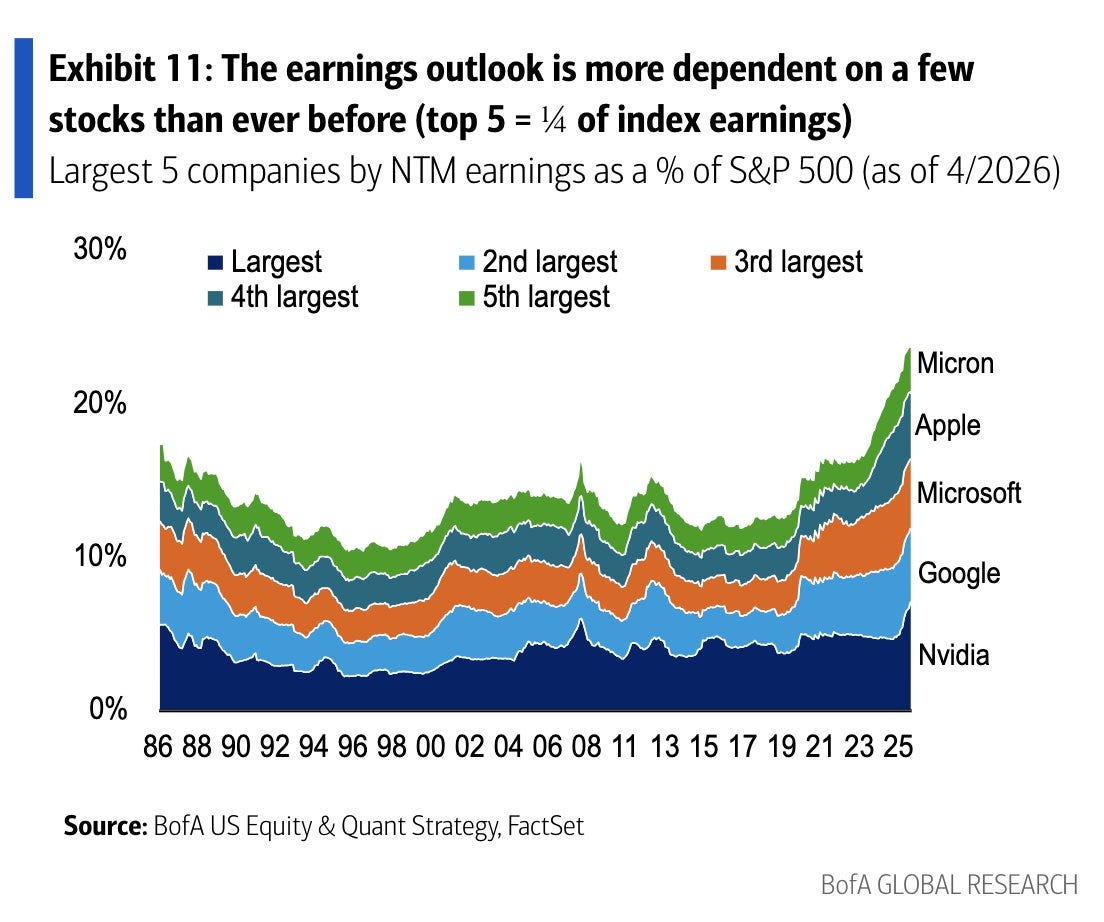
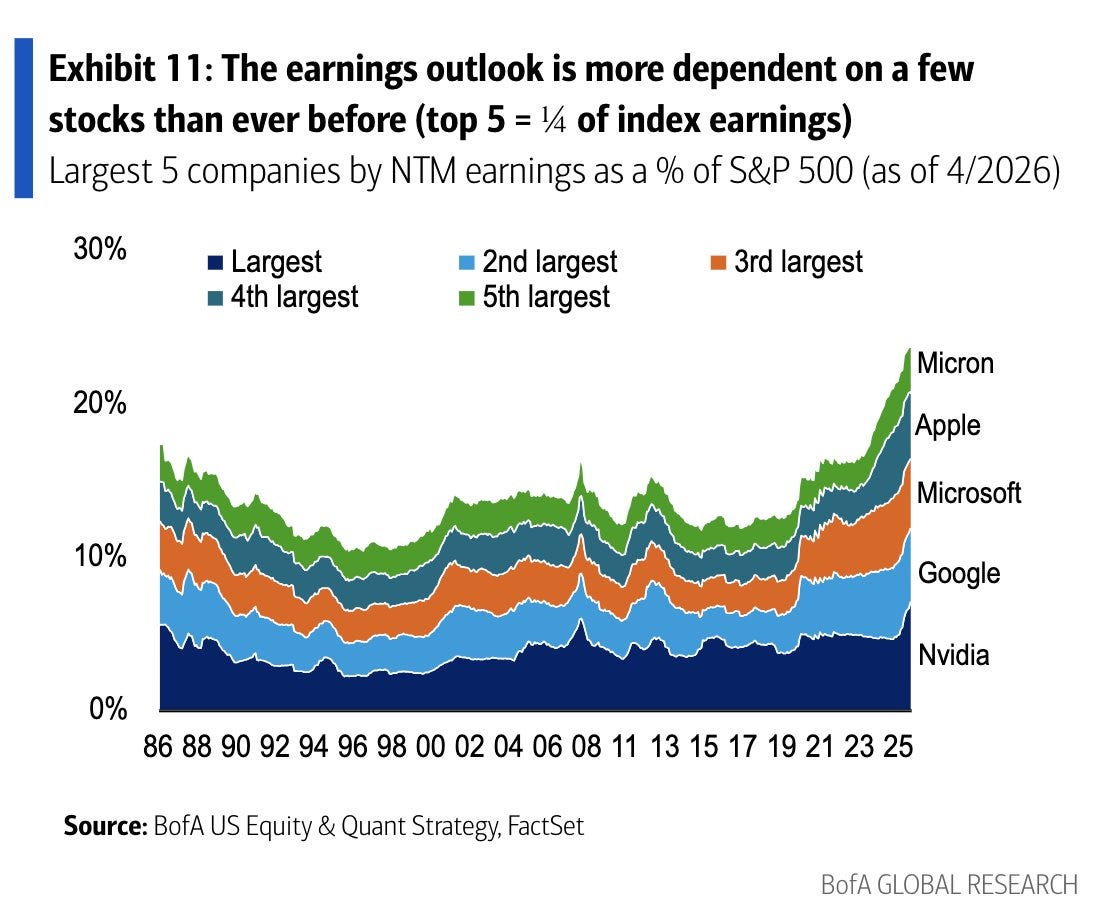
This does not invalidate the structural thesis around SK Hynix, memory or AI. In fact, Korea is probably one of the markets most directly benefiting from the scarcity of advanced semiconductors and the global need for memory capacity. But it does suggest that the market is entering a much more fragile phase, where the fundamental direction may remain positive while the short-term asymmetry deteriorates. In fact, when looking at the outlook for corporate earnings, it is increasingly dependent on just a handful of names — 25% coming from only five companies — which is never a sign of market health.
Inflation is once again hitting new highs, leaving the Fed with no room to maneuver. April CPI rose to 3.8% year over year, the highest reading since May 2023, with a 0.6% monthly increase, while core inflation accelerated to 2.8%, clearly above the Fed’s target. Energy accounts for more than 40% of the increase, with gasoline up 28.4% year over year and fuel oil up 54.3%. But the truly worrying point is that core inflation is also accelerating — and this only reflects one month of higher crude prices. Services inflation remains alive, with shelter at 3.3% and food at 2.3%, meaning this can no longer be attributed solely to crude. The pass-through from the energy shock is beginning, not ending.
PCE, the metric that truly matters for the Fed, confirms the same story. Headline PCE is already at 3.5% year over year, and the Philadelphia Fed’s Survey of Professional Forecasters projects PCE at 4.5% and core PCE at 3.4% for the second quarter, compared with previous estimates of 2.7% just three months ago. In a very short period of time, consensus has gone from projecting a normalization toward target to accepting figures not seen since 2022. And this still does not incorporate the upward shift in the crude forward curve already visible in the market, with firms such as Piper Sandler projecting Brent above $100 for both this year and next. If this materializes, Q2 and Q3 will be substantially worse than the current data.
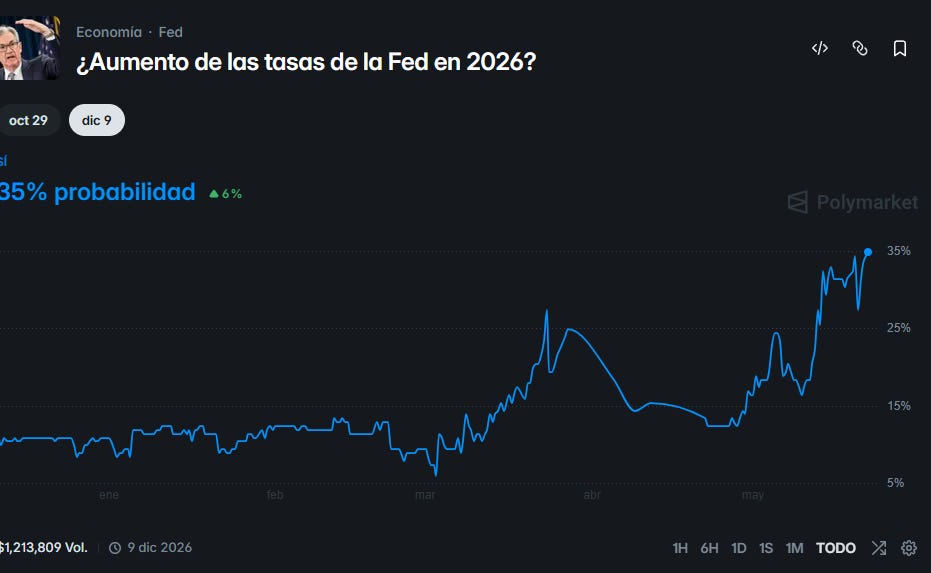
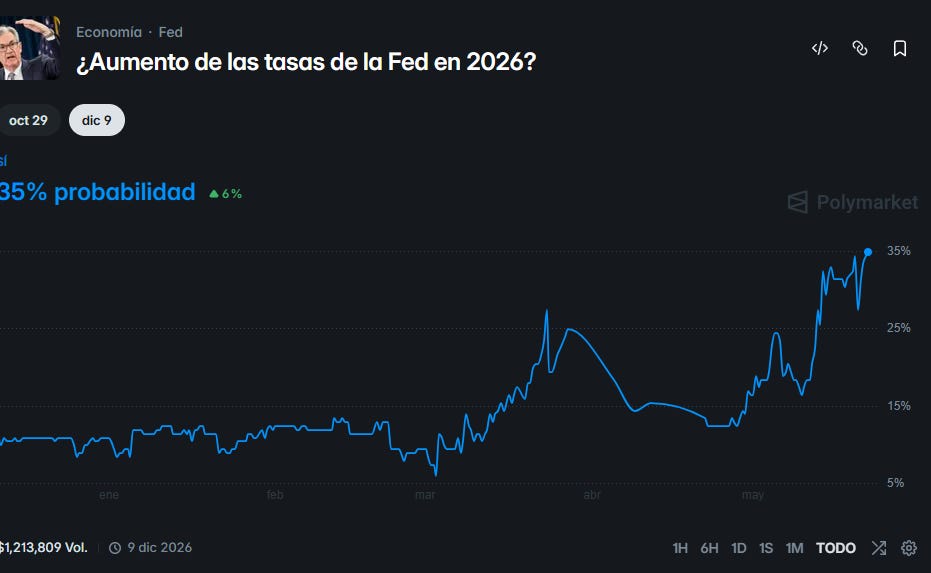
The transition from Powell to Warsh could not come at a worse time. Warsh was nominated with the explicit expectation of cutting rates, but the minutes from the latest meeting show that most of the committee already anticipates hikes if inflation continues to apply pressure. The market has gone from pricing in four cuts for 2026 to just one, and now assigns a 37% probability to a rate hike before year-end. Any attempt to steer the committee toward cuts with this data would be interpreted as pure politicization, destroying anti-inflation credibility. Trump’s proposal to suspend the federal gasoline tax follows the same flawed logic as cutting rates in this environment: stimulating demand in the face of a supply shock is the textbook example of what not to do. Higher for longer, including rates. If Warsh allows it.
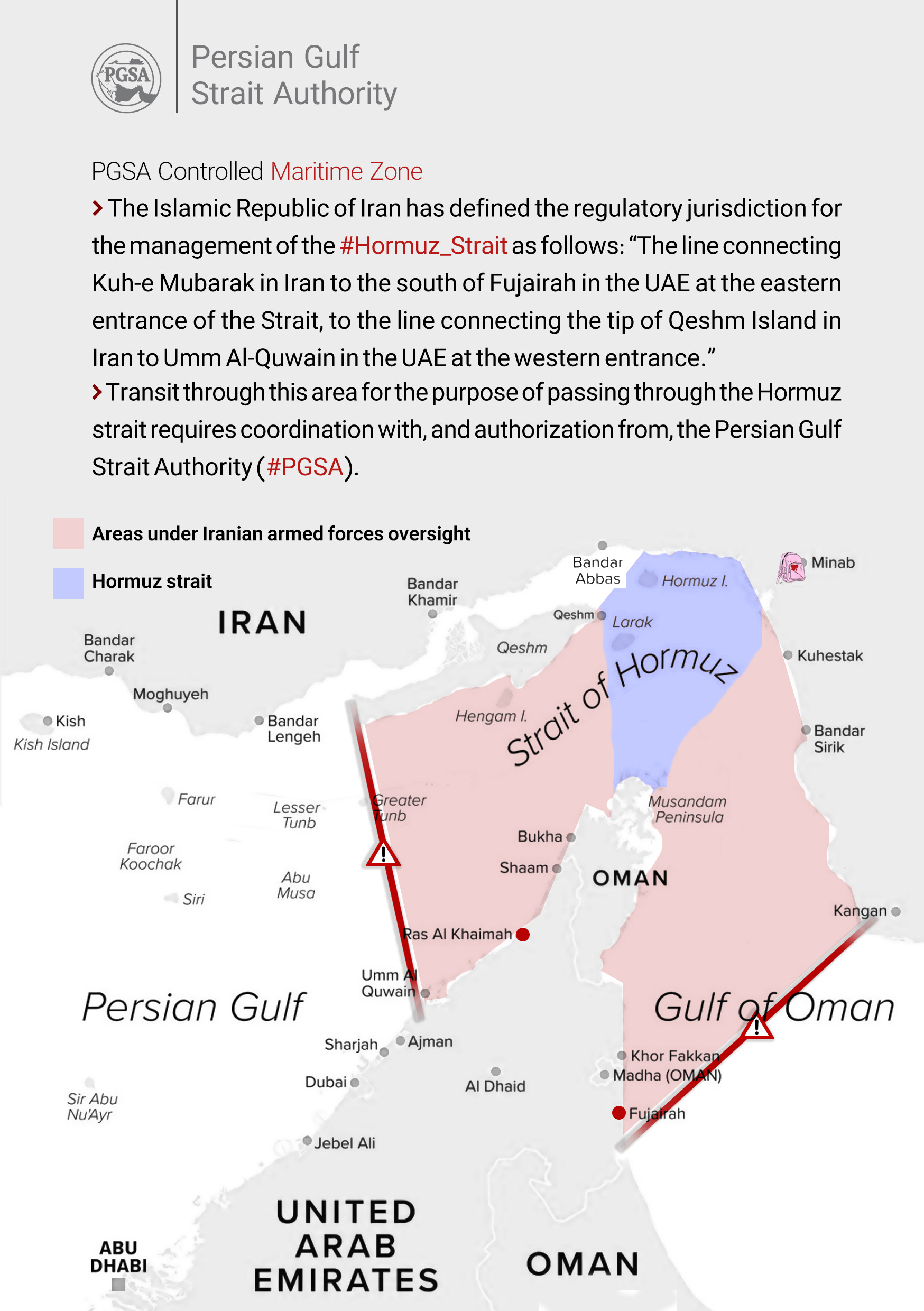
I see the possibility of an agreement between the United States and Iran as highly unlikely, since there are two issues, both the nuclear question and the Strait, where the positions appear irreconcilable. Iran is once again using the Strait of Hormuz as a geopolitical lever, this time not through a direct threat to close it, but through a more subtle formula: the administrative redefinition of the area under supervision and the requirement for prior coordination for the use of frequencies within the maritime corridor. On paper, the measure is presented as a technical mechanism for managing maritime traffic, delimiting the area between Kuh Mobarak and southern Fujairah in the east, and between Qeshm and Umm al-Qaiwain in the west. In practice, however, it represents an attempt to strengthen Iran’s ability to control one of the world’s most important energy chokepoints.
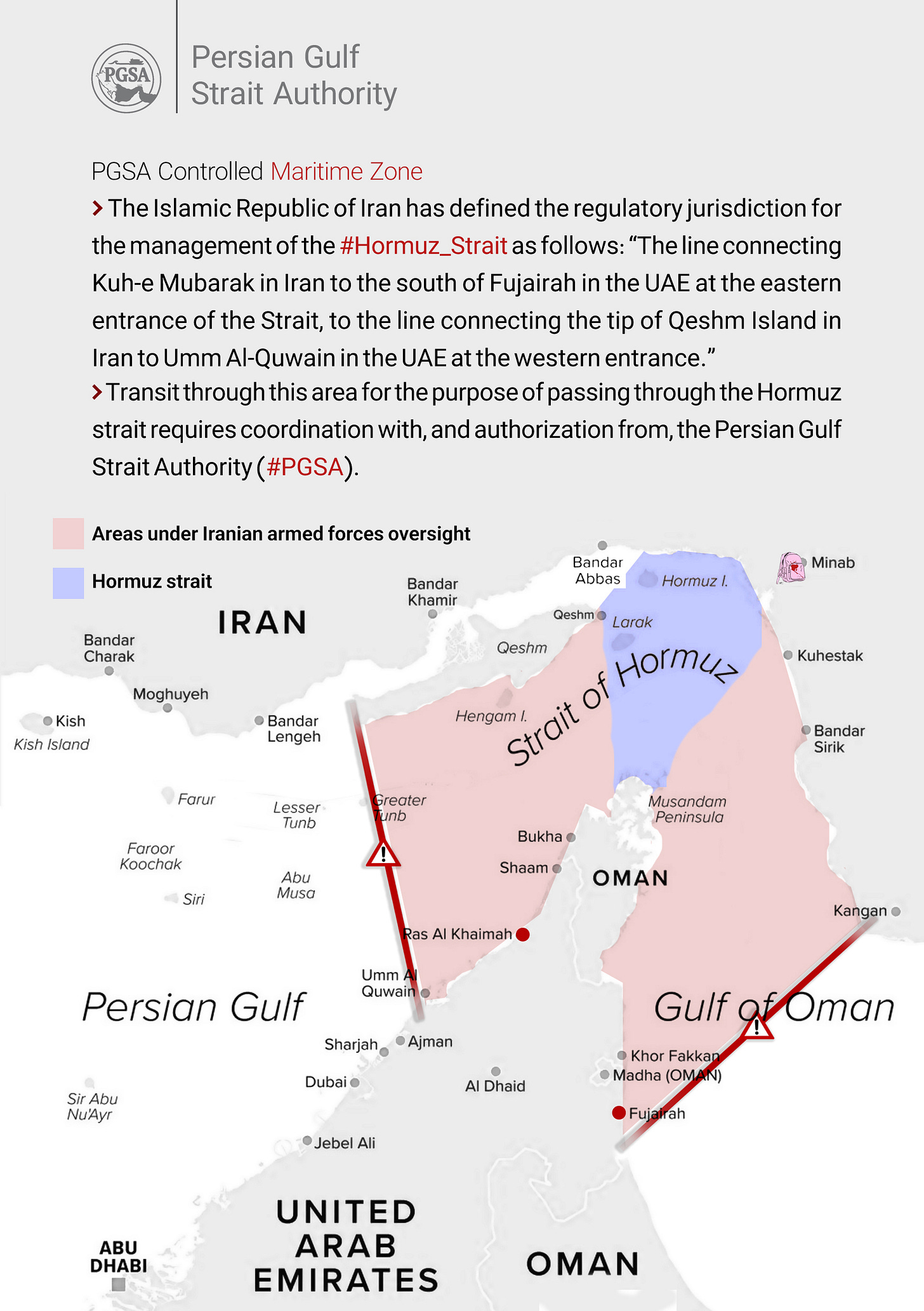
The key issue is not only whether Iran carries out a physical disruption, but that it is showing a willingness to turn energy traffic into a tool of pressure. Marco Rubio has already confirmed that a toll in the Strait is unacceptable to them, and also to the Gulf countries, since it would give Iran de facto control over OPEC+. Therefore, in order to reach an agreement, they would have to concede either on the nuclear issue or on the Strait, or otherwise attempt to open it by force.
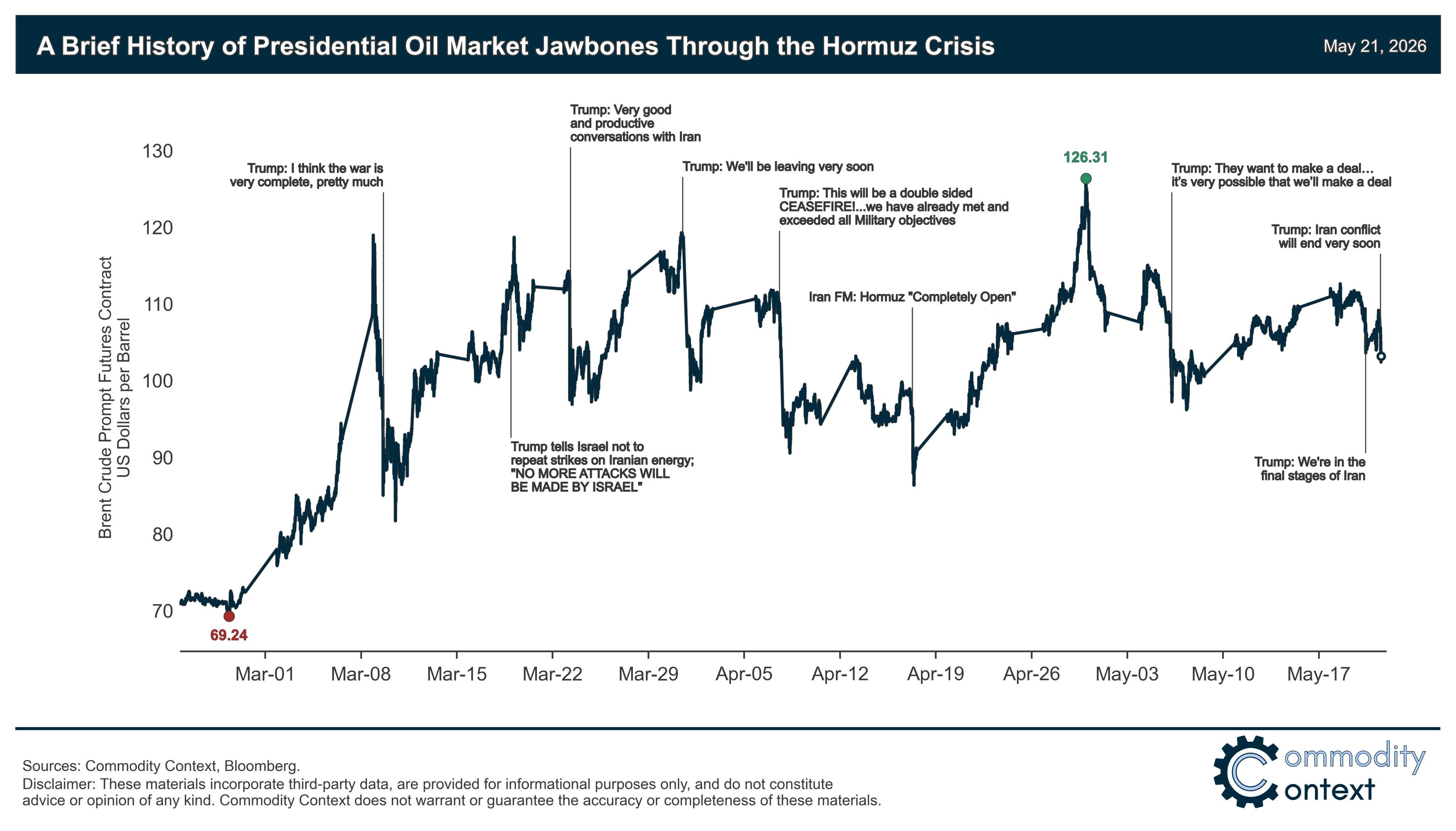
One of the most relevant points now starting to appear in reports from major banks is that the physical oil market no longer has much room to keep absorbing a closure of the Strait of Hormuz. JPMorgan puts it quite directly: Hormuz will have to reopen one way or another, because if it does not do so before June, global inventories will reach critical levels. The key issue is not only the volume of barrels that are no longer leaving the Middle East, but the speed at which visible inventories are being drained. In just two weeks, observable stocks — satellite data, crude in transit and EIA data — would have fallen by around 121 million barrels. Goldman has also validated this dynamic, estimating visible withdrawals of close to 8.7 million barrels per day during May. These are enormous figures, difficult to reconcile with the apparent calm in prices, which remain at the mercy of increasingly dubious and desperate headlines.
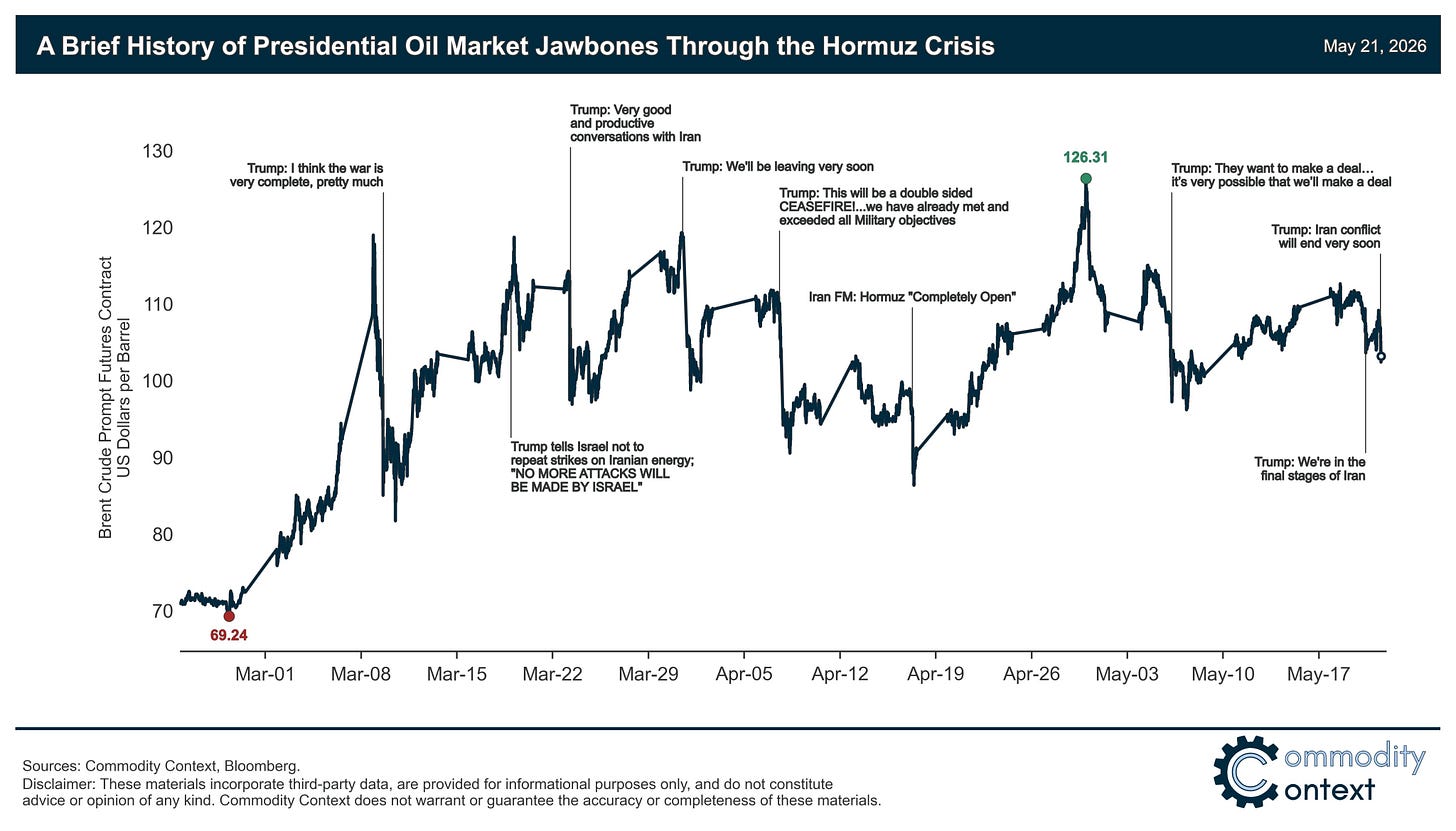
The problem is that even if Hormuz reopens, the market does not automatically return to normal. There is a logistical constraint that financial markets tend to underestimate. Shut-in production does not come back online overnight, cargoes do not instantly reappear, and export chains take weeks — probably months — to rebuild. According to JPMorgan, even if the strait reopened now, Middle Eastern flows would not return to normal until August at the earliest. In other words, the market would continue to lose inventories even after the reopening. This explains why many traders are waiting precisely for that moment to position long with greater conviction. A reopening of Hormuz could trigger an initial bearish reaction on the headline, but the physical fundamentals would remain bullish: shut-in production, logistical delays, falling inventories and a growing need to release strategic reserves. In fact, at the current pace, the market is heading toward a cumulative loss of up to 1.59 billion barrels, a figure that vastly eclipses the roughly 400 million barrels released from the SPR in previous episodes.
The paradox is that attempts to contain prices through headlines, reserve releases and political measures may be delaying the natural demand adjustment. Japan, for example, is carrying out one of the largest reserve releases in its history and trying to keep prices at pre-conflict levels, which in practice stimulates consumption rather than destroying it. In the United States, demand would even have increased by around 600,000 barrels per day, while the net decline across Japan, China, Europe and the U.S. would barely amount to 500,000 barrels per day across almost half of global demand. There is no clear historical analogue for a supply shock of this magnitude combined with low inventories, logistical delays and governments trying to cushion the impact on prices. The key message is that a reopening of Hormuz would not immediately solve the deficit; it would simply mark the beginning of a slow normalization process. Until then, oil will depend less on daily headlines and more on a much more uncomfortable physical reality: barrels are missing, and inventories are falling too fast.
Model Portfolio
Year to date, the model portfolio is up +23.98%, versus +11.07% for the S&P 500 (S&P in euros), and +219.6% since inception (September 2022), compared with +66.9% for the S&P 500. The model portfolio, as of Friday's close, is as follows:
⚠️Past performance does not guarantee future results. The historical performance of the model portfolio is shown for informational and educational purposes only and does not constitute investment advice or an offer to buy or sell securities. The returns shown may not include fees, taxes, or other associated costs.
