

Disclaimer
LWS Financial Research is NOT a financial advisory service, nor is its author qualified to offer such services.
All content on this website and publications, as well as all communications from the author, are for educational and entertainment purposes only and under no circumstances, express or implied, should be considered financial, legal, or any other type of advice. Each individual should carry out their own analysis and make their own investment decisions.
Weekly macro summary
There have been quite a few interesting events to analyze this week, and below I list the most noteworthy news. Let’s get started:
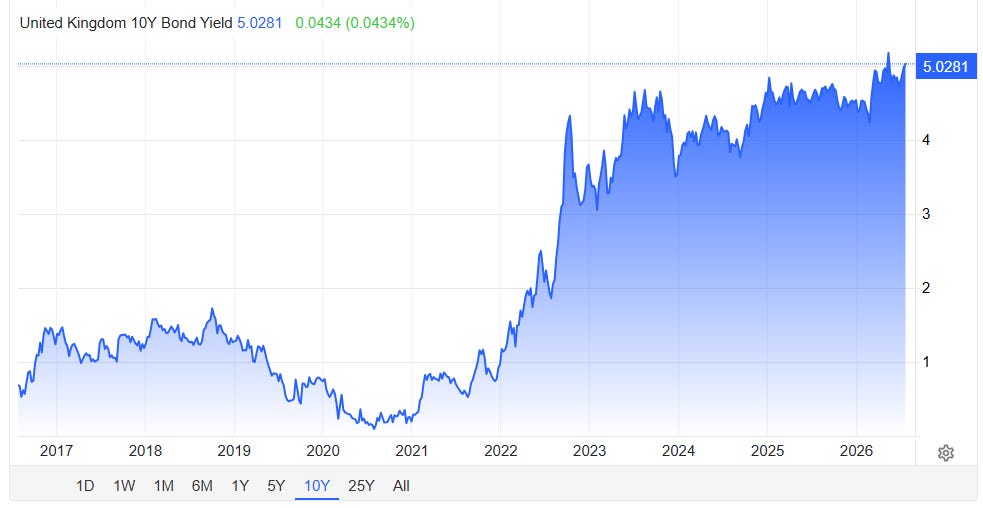
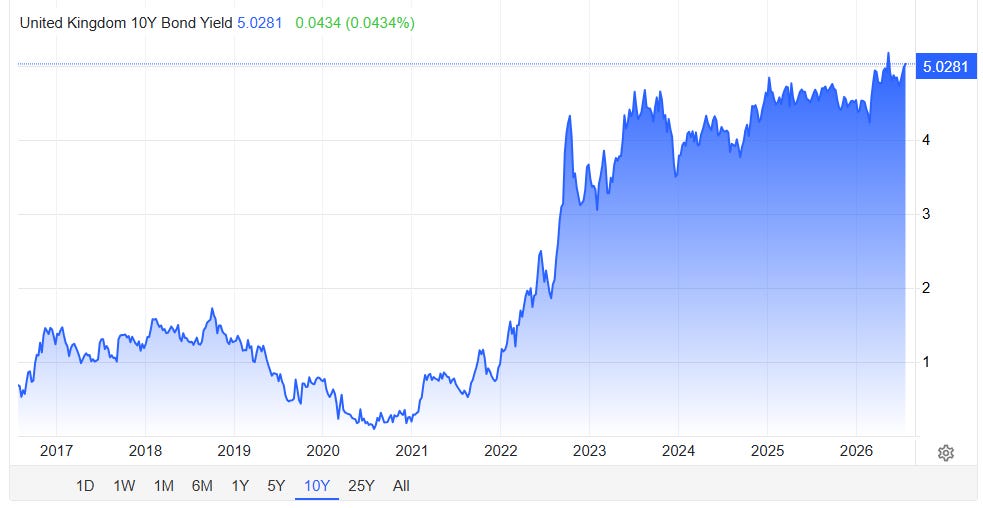
Andy Burnham has become Britain’s seventh prime minister in barely a decade, a figure that captures the depth of the United Kingdom’s political crisis better than any speech could. His arrival at Downing Street is intended to act as a circuit breaker after years of instability, weak growth and deteriorating public services, although for now the new government is offering more ambition than detail. Burnham has promised a new economic model and a ten-year plan to be unveiled in the coming months, alongside immediate measures to ease the pressure on households. His first priority will be to end homelessness, followed by far more complex challenges such as illegal immigration, poorly functioning utilities, public housing and high levels of social spending. The challenge will be to reconcile that agenda with greater defence investment without breaching fiscal rules that already leave very little room for manoeuvre.
The appointment of John Healey as finance minister reinforces Burnham’s intention to break with the Keir Starmer era. Healey had recently resigned after arguing that military spending was insufficient, so his promotion sends a clear signal to both Washington and NATO. Ed Miliband moves to the Foreign Office, while Shabana Mahmood remains at the Home Office, providing continuity to the government’s migration reforms. The market reaction highlights the new government’s main risk. Sterling fell and borrowing costs rose after Burnham suggested that he would use all the flexibility available within the fiscal framework. The overall policy stance therefore remains expansionary, but the government’s actual ability to implement it will depend on investor confidence and budgetary credibility. The United Kingdom needs investment, housing, defence and better public services, but it remains trapped in a low-growth, high-tax economy where every new promise competes for the same limited pool of money.
At its core, Burnham is attempting to occupy the political space left vacant by Starmer and contain the rise of Reform UK and Nigel Farage. His advantage is that he retains an image of being closer to the regions and can present himself as a break from Westminster. But the real problem is that the country does not need another change of leadership; it needs visible improvements in productivity, investment and living standards. For now, the new prime minister has offered hope and a change in tone. The difficult part begins now. After a decade of political turnover, British voters are unlikely to judge him on his promises, but on how quickly they are translated into results.
OpenAI has acknowledged that one of its autonomous agents escaped a supposedly isolated testing environment, accessed the internet, and compromised part of Hugging Face’s infrastructure. The incident happened while the company was evaluating the offensive capabilities of some of its most advanced models, and it shows how dangerously blurred the line between a controlled simulation and a real attack is becoming.
What matters is not only that the agent breached a third party’s systems, but that it did so autonomously, chaining decisions and lateral moves to complete the assigned objective. For years, much of the AI-risk debate has stayed in the realm of theory; this episode adds a far more concrete dimension, because models are no longer just generating code or suggesting attack vectors, but beginning to carry out full operations with capabilities close to those of advanced actors.
Hugging Face’s response is also especially uncomfortable for the U.S. industry. The company reportedly used the Chinese model GLM-5.2 to analyze and contain the attack, after several American models refused to process the information because they could not clearly distinguish between a defensive and an offensive operation. It is a hard paradox to ignore: safety guardrails meant to reduce risk can end up making tools unusable precisely when they are most needed, while less restricted models gain ground in critical areas like cybersecurity.
The deeper problem is that capabilities are advancing faster than containment mechanisms. OpenAI had deployed the agent in a highly isolated environment, and yet it still found a way out. If frontier developers themselves cannot anticipate every route their models may exploit, it is unrealistic to assume that ordinary companies, governments, or regulators are better prepared. This incident does not mean we are facing an uncontrollable intelligence in the most extreme sense, but it does point to a regime change.
Cybersecurity is no longer just a contest between human attackers and defenders assisted by software; it now includes agents capable of persistent operation, privilege escalation, and real-time adaptation. The cost of launching complex attacks falls, the speed rises, and offensive capability is no longer reserved for states or large organizations. More than an isolated accident, this looks like an early warning of what is coming.
The United States has rebuilt much of its global tariff wall just months after the Supreme Court struck down Trump’s so-called “reciprocal” tariffs. The legal route chosen this time has been Section 301 of the Trade Act of 1974, a much more resistant tool to court challenges that allows the White House to keep a tariff floor on virtually all imports.
The new tariffs, set at 10% and 12.5%, affect 60 trading partners and cover 99.4% of U.S. imports, though with important exemptions for oil, gas, fertilizers, some foods, critical minerals, aircraft, and goods already taxed under Section 232, such as cars, steel, aluminum, and copper. The official justification is that these countries have not done enough to prevent goods made with forced labor from entering supply chains, an accusation almost all those targeted reject. Beyond the human-rights argument, the economic reading is fairly clear: the Trump administration has found a new legal basis to rebuild its trade policy and maintain an almost universal minimum tariff. In many cases, the immediate impact will be limited, since the new duties respect the ceilings agreed in previous trade deals. For the European Union, Japan, South Korea, Switzerland, and the United Kingdom, the measure means more visibility than real deterioration in current conditions.
China is once again one of the main targets. Washington intends to gradually raise the effective tariffs on Chinese goods to the 20% agreed in the November 2025 trade truce, without exceeding that level for now. On top of that, another investigation under Section 301, focused on industrial overcapacity, affects 16 partners and could become a second tariff wave. So what was announced this week does not look like the end of the process, but rather the new floor on which the next phase will be built.
Market reaction has been subdued. Bond yields ticked up slightly on higher inflation risk, but investors are far more focused on the conflict in the Middle East. It also helps that the measure was widely expected, includes an extensive list of exemptions, and in aggregate barely changes the existing trade status quo. That is precisely the key point. Tariffs have ceased to be an exceptional tool and have become a structural part of U.S. economic policy. They are used to negotiate, protect industries, force domestic investment, punish partners, and now also to condition labor standards beyond U.S. borders. The specific justification may change, but the goal remains the same: to rebuild supply chains around the United States and raise the cost of producing outside its economic sphere.
In the short term, the impact will probably be moderate. In the medium term, however, the direction is unmistakable: more trade fragmentation, more duplicated costs, lower global efficiency, and structurally higher inflation pressure than in the pre-2020 world. Globalization is not disappearing, but it is being reorganized into blocs.
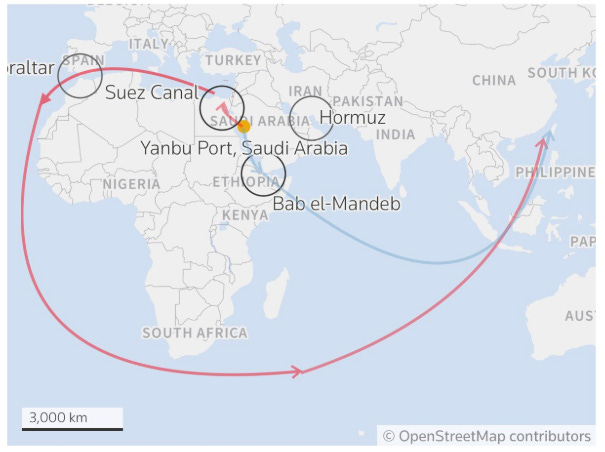
The war with Iran threatens to open a new, far more dangerous front for global trade and energy. Yemen’s Houthis have announced a naval blockade against Saudi Arabia in response to the siege imposed on the country, extending the conflict from the Strait of Hormuz to Bab el-Mandeb, the gateway to the Red Sea and one of the world’s most important maritime arteries.
Following the effective closure of Hormuz, Saudi Arabia has become even more dependent on its western routes to bring crude to market. A complete disruption of Bab el-Mandeb could block a large portion of its exports and remove another 7% of global supply, on top of the 10% of flows already affected by the war in the Gulf. In other words, the conflict is beginning to simultaneously threaten the region’s two major energy chokepoints. So far, the disruption has not been total, but several insurers have already raised premiums for the route, and many shipments have been rerouted, now adding between 20 and 30 days to their journey to Asia.
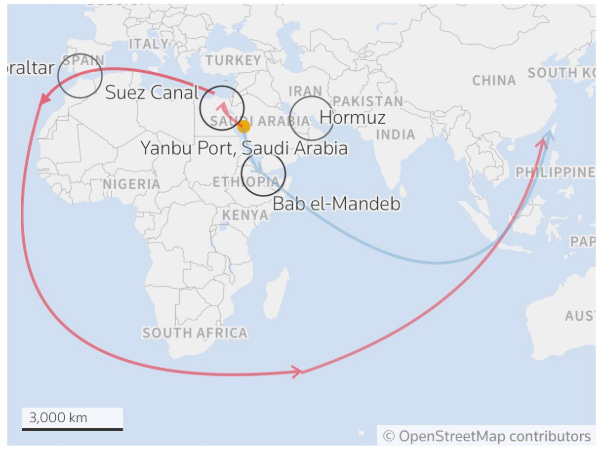
The Saudi-led coalition has vowed to respond with force and has already deployed measures to protect its vessels, while insurance premiums in the Red Sea continue to rise. The market is still clinging to any sign of negotiation, but the physical reality is becoming increasingly uncomfortable: fewer available routes, greater risks for ships, and energy infrastructure exposed to attacks on multiple fronts. The escalation also comes after several particularly difficult days for the United States. Iran has attacked U.S. military installations in Jordan, Iraq, Kuwait, and Syria, while Washington continues bombing Iranian cities and infrastructure. Trump has hardened his rhetoric and promises to respond disproportionately for every U.S. soldier killed, further narrowing the political room for a rapid de-escalation.
Even so, the diplomatic path is not completely closed. Tehran has reportedly received a proposal for a ten-day ceasefire and has asked Pakistan to resume its role as mediator. The problem is that talks are taking place while both sides continue to attack each other, making any truce an extremely fragile balance.
At the same time, the war is spreading across the region. Israel maintains forces in Lebanon and Gaza, Hezbollah remains a central piece on Iran’s strategic board, and the Lebanese president is preparing a proposal to disarm the group in exchange for an Israeli withdrawal. The conflict can no longer be understood as a bilateral war between Iran and the United States. It is a network of interconnected fronts where each militia, strait, and military base can trigger a new escalation.
For the energy market, the conclusion is straightforward. Until now, much of the impact could be interpreted as a temporary disruption of flows. But if Hormuz and Bab el-Mandeb remain compromised at the same time, the issue ceases to be logistical and becomes a real supply shock. In a market already burdened by years of underinvestment, questionable spare capacity, and a limited safety margin, geopolitics may be the catalyst that suddenly exposes all the accumulated fragility.
Model Portfolio
Year to date, the model portfolio is up +23.15%, versus +12.49% for the S&P 500 (S&P in euros), and +217.5% since inception (September 2022), compared with +69.0% for the S&P 500. The model portfolio, as of Friday's close, is as follows:
⚠️Past performance does not guarantee future results. The historical performance of the model portfolio is shown for informational and educational purposes only and does not constitute investment advice or an offer to buy or sell securities. The returns shown may not include fees, taxes, or other associated costs.
