

Disclaimer
LWS Financial Research is NOT a financial advisory service, nor is its author qualified to offer such services.
All content on this website and publications, as well as all communications from the author, are for educational and entertainment purposes only and under no circumstances, express or implied, should be considered financial, legal, or any other type of advice. Each individual should carry out their own analysis and make their own investment decisions.
Introduction and business model
Whitecap Resources is one of Canada’s leading oil and gas producers, with a business model that combines two clearly differentiated divisions — a low-decline conventional division and a growth-oriented unconventional division — and a clear commitment to shareholder returns through a sustainable monthly dividend and an opportunistic buyback program.
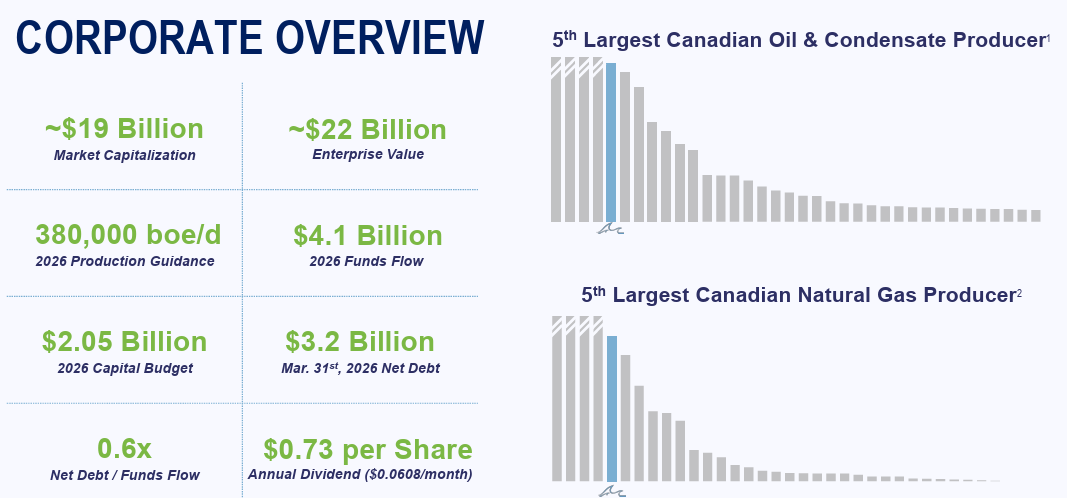
Following the merger with Veren, completed in May 2025, Whitecap has become the 5th largest oil & condensate producer in Canada and, at the same time, the 5th largest natural gas producer, with 2026 production guidance of 380,000 boe/d — 61% liquids and 39% natural gas — and projected free funds flow of more than C$2 billion at US$80/b WTI.
Unlike more leveraged companies — such as Saturn Oil, which we analyzed a few weeks ago — Whitecap’s proposition is the opposite: a strong balance sheet, BBB investment-grade rating from DBRS, contained leverage of around 0.6x net debt/funds flow, decades of inventory, and a highly disciplined capital allocation framework that prioritizes the balance sheet, dividend and per-share growth, in that order. It is the perfect barbell to SOIL’s extreme leverage for playing the same “higher for longer” crude oil environment.
The business model is built around two pillars with very different operating profiles:
Conventional Division: This division represents around 137,700 boe/d proved, with assets across four regions: Alberta Conventional — Cardium, Boundary Lake, Charlie Lake and Glauconite — West Saskatchewan — Viking light oil + Shaunavon medium oil — East Saskatchewan — Mississippian + Viewfield Bakken — and Weyburn, one of the largest CCUS projects in the world, where Whitecap operates a 65.3% working interest. These are high-quality assets: 30°–40° API light oil, elevated netbacks, established infrastructure, low base decline — 3–5% at Weyburn thanks to the CO₂ flood — and significant room for optimization through extended-reach horizontal wells, open-hole multilaterals and further EOR/waterflood expansion. In total, the conventional division has 5,800 inventory locations.
Unconventional Division: This is the growth engine, with three regions: Gold Creek/Karr, Kaybob and Smoky — Kakwa, Lator, Musreau and Resthaven. Whitecap is the largest landholder in Alberta across the Montney and Duvernay, with 1,500,000 acres, a competitive position that is difficult to replicate. Production stands at 242,184 boe/d proved, with 4,700 identified locations, of which around 80% remain unbooked — a significant source of future upside. The economics are the best in the portfolio: payouts of 0.7–1.2 years, IRRs above 100% in oil/condensate and liquids-rich areas, and P/I ratios of 1.1x–1.4x.
At the reserve level, the company has an exceptional balance:
PDP: 700 MMboe
1P: 1.5 Bnboe
2P: 2.2 Bnboe
2P RLI: 16.1 years
The pre-tax NPV10 of 2P reserves is C$21.7 billion, which, compared with a current EV of around C$23.5 billion, makes it clear that the market is essentially paying only for proved and probable reserves at reasonable prices — WTI at US$71.93/b in 2026, rising to US$73/b in 2027 — while assigning no value to the unbooked inventory, macro catalysts or growth optionality.
The merger with Veren, completed in May 2025 through the exchange of around 643 million shares, with no cash payment, has been transformational. It has not only doubled the size of the company — from around 177k boe/d to 380k boe/d — but has also established Whitecap as a direct peer to Canadian Natural, Cenovus and Tourmaline in terms of scale, while offering a superior liquids mix, a leading Montney/Duvernay position and a significantly cleaner balance sheet.
It is probably the most relevant M&A transaction in the Canadian energy sector in recent years and, given the expected operational and financial synergies, one of the least digested by the market.
Before getting into the thesis, it is worth putting the opportunity into context. As we had been arguing in the Saturn analysis and in the weekly summaries, the oil market has shifted, in a matter of months, from pricing in a structural surplus to facing the largest supply disruption in decades. The conflict with Iran and the restriction of flows through the Strait of Hormuz — through which around 20% of global crude supply used to transit — have exhausted the inventory cushion that supported the bearish narrative. First, oil on water and floating storage disappeared; from that point onward, any further deterioration has to show up directly in a visible drawdown of crude inventories, refined product inventories or, ultimately, demand destruction. And that last leg, for now, is not happening.
The speed of the drawdown is what truly matters. Observable inventories have fallen at a pace that banks such as JPMorgan and Goldman estimate at several hundred million barrels in just a few weeks, to the point that Hormuz will have to reopen in one way or another before global inventories reach critical levels. But here lies the key point that financial markets are underestimating: reopening does not immediately normalize the situation. Production shutdowns are not reversed overnight, cargoes do not reappear instantly, and export chains take weeks — probably months — to rebuild. Even if the Strait reopened today, Middle Eastern flows would not return to normal until well into the second half of the year, meaning the market would continue to lose inventories even after the reopening. This explains the aggressive backwardation in near-term contracts: the market is rewarding the barrel available today far more than the future barrel, exactly what one would expect when scarcity is concentrated in physical crude rather than in a simple financial dislocation.
The consequence is a demand tailwind to rebuild inventories which, in my view, puts a structural floor under the price above $75/bbl WTI, a level that is already highly attractive for most producers. We are not talking about a temporary spike, but about a regime of persistently higher prices. Even the IEA, historically bearish on crude, now projects a deficit extending through the end of the year, while firms such as Piper Sandler place Brent above $100/bbl for this year and next. Higher for longer, also in oil. The question, therefore, is not whether the environment is constructive, but which companies are best positioned to capture it without taking on excessive risk. And that is where Whitecap comes in.
Investment idea
To answer the question of whether Whitecap can be a good investment opportunity at these prices — after rising 95% over the past twelve months — we are going to analyze the following sections:
Assets and business units
Operations and financials
Balance sheet and shareholder return
Valuation
Let’s get started.
